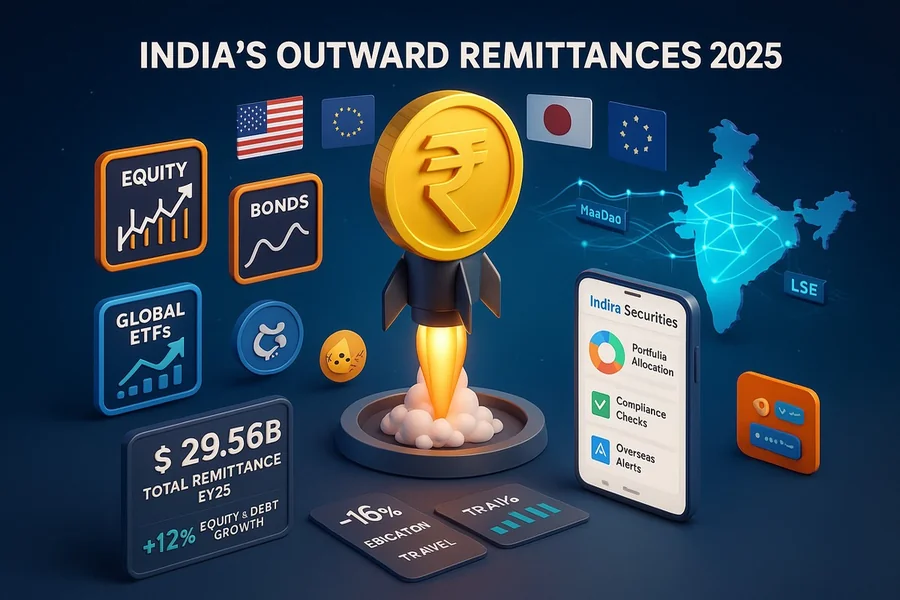
India’s markets are buzzing, but more NRIs and resident Indians are realising that putting all their money in one country is risky. Rupee volatility, sector-heavy indices, and global uncertainty are pushing investors to look beyond domestic stocks. Instead of replacing India, many are now using demat for NRI to add international assets and create balance in their overall portfolio.
Why NRIs Are Looking Beyond India
Indian equities have delivered strong returns, but the market is heavily tilted towards financials, IT, and a few large groups. If these pockets underperform, an investor’s entire portfolio can suffer. When NRIs or residents spread money across the US, Europe, or other developed markets, they reduce this “home bias” and avoid depending only on the Sensex or Nifty. It also helps them earn in stronger currencies like the US dollar, which is useful for long-term goals such as children’s overseas education or settling abroad later in life.
How an NRI Demat Account Makes It Easier
Forms, approvals, paperwork, and legal confusion used to make buying abroad seem tough. Now, opening a compliant NRI demat with Anand Rathi and trading account is largely digital. You typically complete KYC with documents such as PAN, passport, overseas address proof, and link it to an NRE or NRO bank account. Once this is done, you can use the same platform to invest in Indian shares, mutual funds, bonds, IPOs, and, through a global access arrangement, foreign stocks and ETFs as well.
Using NRE and NRO Accounts the Right Way
For NRIs, the choice between NRE and NRO accounts matters.
- An NRE-linked demat is usually used for money earned abroad that you want to invest in India and later send back overseas. Funds and capital gains are generally repatriable, subject to rules.
- An NRO-linked demat is meant for income earned in India—rent, pensions, dividends, interest, and so on. This money is mostly non-repatriable, except within specified limits, but it is convenient for managing Indian cash flows and investments.
Having separate structures for repatriable and non-repatriable money allows you to match each pool of funds with the right goal and tax treatment.
Global Access From One Login
Modern platforms now offer a single sign-on where you can see both your Indian and international holdings. Through one interface, you can buy US tech stocks, global bond ETFs, or international index funds, alongside your Indian mutual funds and equities. Fractional investing is another big advantage: instead of needing thousands of dollars to buy a high-priced US stock, you can purchase a small slice with a much lower ticket size. This lowers the entry barrier for younger investors and those testing global markets for the first time.
Dealing With Tax and Compliance
Tax is usually what worries NRIs most, especially when two countries are involved. India and many other countries have Double Taxation Avoidance Agreements (DTAA) that are designed to keep you from paying taxes on the same salary twice. When DTAA relief is available, a well-designed NRI platform will apply the proper rate, clearly show TDS charges, and provide accounts that you may give to your tax expert. In terms of compliance, the system must route trades through NRE/NRO accounts, stick to FEMA, RBI, and SEBI rules, and respect resident investment limits under the Liberalized Remittance Scheme (LRS).
Costs, Brokerage, and Hidden Charges
Another reason global investing is gaining traction is that costs have become more transparent. Many providers now waive account-opening fees and custody charges, and charge a simple brokerage on trades, sometimes with promotional periods of zero brokerage. Flat withdrawal fees and clear currency conversion charges help you know your all-in cost. This is quite different from the earlier days when high charges quietly ate into returns and made overseas investing unattractive for smaller portfolios.
Different Investor Profiles, Different Setups
Not every NRI needs the same product structure. Some may be satisfied with a simple NRE demat for long-term equity and mutual fund investing. Others with bigger holdings or more skill may invest in particular kinds of assets through other controlled routes or other arrangements under the Portfolio Investment Scheme. The key is that you may match goods to your objectives: investors who are focused on income may favor high-dividend foreign stocks and bond funds, while those who are focused on growth may favor technology, healthcare, or themed exchange-traded funds.
Young Investors and the “Global First” Mindset
Younger Indians and NRIs are especially comfortable with the idea of earning in rupees but investing in dollars and euros. They have grown up using global tech platforms, so owning shares in those companies feels natural. With app-based onboarding, instant charts, live prices, and the ability to buy small quantities, global diversification feels as simple as ordering food online. For them, keeping everything in one country feels riskier than holding a mix of Indian and international assets.
Policy Support and the Role of GIFT City
Recent policy moves have made invest abroad smoother. The development of GIFT City as an international financial hub allows Indian intermediaries to route many global products through an onshore structure with Indian regulation and protections. Combined with the LRS limits for residents and clear rules for NRIs, this gives a defined framework: you know how much you can remit, what is allowed, and how to bring money back when needed.
Balancing India and the Rest of the World
Ultimately, the idea is not to abandon India’s growth story. Strong long-term potential is still possible in the country through fixed income, investment funds, and stocks. Spreading out some of your wealth abroad, however, can protect you from local slowdowns, sector-specific shocks, and currency weakness. A well-chosen NRI demat setup and a global access platform like Anand Rathi shares and stock broker let you hold both India and the world in a single, regulated structure. That mix—rooted in India but open to global opportunities—is what helps investors sleep better, no matter how the rupee or the index behaves on a given day.