
London is a city with old historic buildings and new glass towers side by side. This mix creates real challenges for keeping buildings in good shape. The reason rope access is becoming popular for building maintenance in London is simple: it is fast, often cheaper, safe when done correctly, and causes far less disruption than traditional methods.
As the city keeps building higher and older properties need careful attention, rope access (also called industrial abseiling) is now a go-to option for property managers, building owners, and contractors.
It works well on awkward building shapes and in tight city spaces where large equipment is hard to use. For anyone looking for the best rope access company in London, the benefits are easy to see.
What Is Rope Access in Building Maintenance?
Rope access is a professional method that uses ropes, harnesses, and safety gear so trained workers can reach areas that are hard to get to on a building. It is not a risky stunt. It is a controlled, regulated way of working at height, based on techniques first used in climbing and caving. Rope access often removes the need for scaffolding or heavy lifting machines, which makes many jobs quicker and simpler.
How Rope Access Works for High-Rise Buildings
Rope access is built around a key safety rule: double protection. Every technician is attached to two separate ropes at all times, each fixed to its own anchor point. One rope is the main working rope for moving and positioning. The other is a backup safety rope that protects against falls. The technician wears a full-body harness and connects to both ropes using approved devices and connectors.
Before work starts, the team checks anchor points and confirms they meet required standards. Technicians use specialist tools like descenders (for controlled lowering), ascenders (for climbing), and backup devices (to stop a fall). A full site check is completed before starting, including hazard checks and a rescue plan, following the Work at Height Regulations 2005 and IRATA rules.
Common Rope Access Techniques Used in London
Rope access workers use different methods depending on the building and the task:
- Ascent and descent: climbing with mechanical ascenders and descending with controlled devices
- Work positioning: holding a steady working position, often with positioning lanyards, so both hands are free
- Traversing: moving sideways across a façade while hanging on ropes, with at least two separate attachment points
- Aid climbing: moving along a structure by clipping into fixed points
- Lead climbing: used only when there is no other safe access option
These methods follow the IRATA International Code of Practice (ICOP), allowing teams to reach almost any part of a structure in a controlled way.
Why Rope Access Is Gaining Popularity in London
Rope access is not just a passing trend in London. More building owners and contractors are choosing it because it fits the way the city is built and how busy it is.
London’s Changing Skyline and Access Challenges
London has more high-rise offices, luxury flats, and mixed-use buildings than ever, and many have complex shapes. From curved glass towers like The Gherkin to tall residential blocks, routine maintenance can be hard with traditional access systems.
At the same time, London has many listed and protected buildings. These often need gentle repair work, and there may be limits on what you can attach to the building or how much you can change its appearance. In dense areas like Soho or Shoreditch, narrow streets and busy pavements also make it difficult to bring in large equipment without causing major disruption. In 2023, around 60% of London’s high-rise buildings used rope access for outside maintenance, showing how common it has become.
Limits of Traditional Methods Like Scaffolding
Scaffolding and MEWPs (mobile elevated work platforms) can be useful, but in London they often cost more and are harder to manage. Scaffolding is expensive, with average weekly hire rates of £1,000 to £2,000, plus permit fees of £200 to £400 per week in central areas. It can take days or weeks to build, and it may block entrances, pavements, and normal building use.
Scaffolding also needs large amounts of steel and timber, which increases transport and material costs and adds to carbon emissions. For many jobs, rope access avoids these problems and gets work done with far less setup.
What Maintenance Tasks Can Be Completed Using Rope Access?
Rope access can be used for many types of building work, from simple cleaning to repairs and specialist installs.
Window Cleaning and Facade Care
High-rise window cleaning is one of the most common uses. Rope access allows technicians to clean tall glass façades without cradles, lifts, or scaffolding. It also works well for façade care, such as checking, cleaning, repairing, and restoring brick, render, stone, or cladding. Teams can reseal windows and fix sills, casements, and sashes, helping the building look good and stay weather-tight.
Inspection and Building Repair
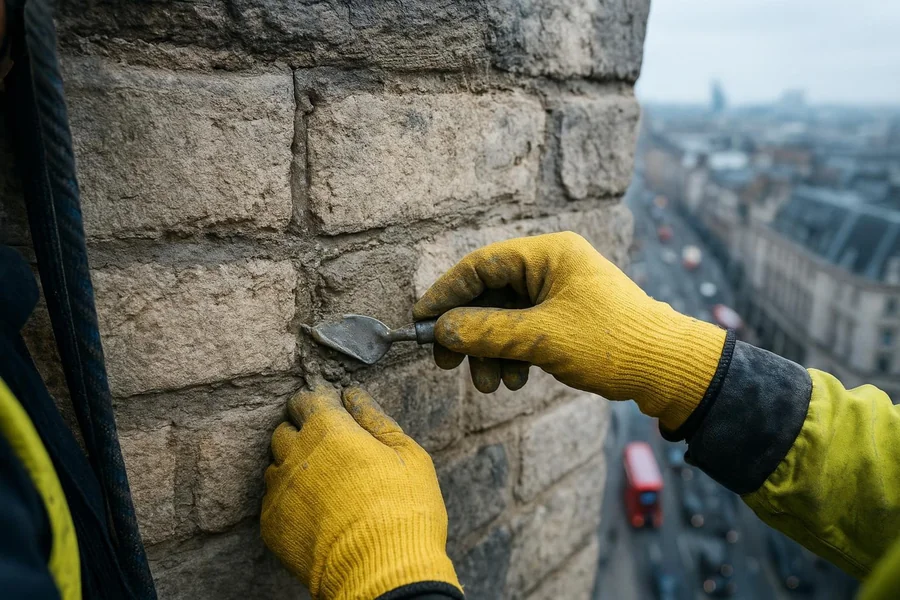
Rope access makes close-up inspections much easier than trying to judge problems from the ground. Teams can spot cracks, loose parts, failed seals, and signs of water damage. Common jobs include leak checks (on roofs, façades, and windows), roof cleaning and repairs, gutter and downpipe clearing, and brick or stone repointing and replacement. Fixing problems early can avoid much larger repair costs later.
Specialized Projects: Cladding, Painting, and Signage
Rope access is also used for many specialist tasks, including:
- Painting at height (surface prep, priming, and coatings)
- Sealant and mastic work around windows, doors, and joints
- Bird proofing (spikes, nets, wires on ledges and roofs)
- Lightning protection installation and maintenance
- Signage installation and upkeep
- Solar panel installation on tall buildings (in some cases)
How Does Rope Access Compare to Traditional Methods?
Compared directly with scaffolding and other access options, rope access often comes out ahead in speed, cost, and day-to-day impact.
Speed and Flexibility Advantages
Rope access is quick to set up. While scaffolding can take days or weeks, rope access teams are often ready to work within 2-3 hours of arriving. This helps with urgent repairs after storms or sudden damage, limiting further problems and cost. It also works well on buildings with complex shapes and areas that machines cannot reach, like narrow riser shafts, atriums, and spires.
Cost Effectiveness for Building Owners
Rope access can reduce costs because there is no need to hire, store, build, or remove scaffolding. A two-person rope access team may cost around £300 to £500 per day, often with no permit costs, which can save £100 to £300 per week in central London. Scaffolding can cost £1,000 to £2,000 per week plus permits.
Here is a simple comparison example:
| Method | Typical cost example | Extra costs |
| Rope access | £300-£500 per day (2-person team) | Usually no pavement permit |
| Scaffolding | £1,000-£2,000 per week | Permits often £200-£400 per week |
On a 10-storey office block, a façade restoration might cost around £15,000 using rope access, while scaffolding could go beyond £40,000. Many London projects see cost cuts of around 30-50% for external maintenance work.
Accessing Hard-To-Reach Areas
Rope access lets technicians place themselves exactly where they need to be, with minimal setup. This works for high-rise exteriors, complex rooftops, interior atriums, and detailed heritage façades. The close access supports better inspections, more accurate cleaning, and precise repairs, which is especially helpful on delicate restoration work.
Disruption Minimization vs. Scaffolding
Rope access usually needs very little space at ground level. That means fewer blocked entrances, fewer closed pavements, and less impact on the people inside the building. Businesses can often keep operating as normal. Teams can also work at night when needed, which helps in busy areas where daytime disruption is a problem.
Does Rope Access Improve Safety?
Rope access can look risky to people watching from the street, but it is one of the safest ways to work at height when carried out by trained, certified teams. Safety is the main focus of every rope access job.
Accident Rate Comparison: Rope Access vs. Scaffolding
Accident data supports rope access as a safer option when compared fairly (per 100,000 full-time equivalent workers). The IRATA Work & Safety Analysis 2024 reports 140 reportable accidents per 100,000 FTE workers for rope access. The NASC Safety Report 2024 reports 540 reportable accidents per 100,000 FTE workers for scaffolding. That is almost four times fewer reportable accidents for rope access. The double-rope system is a major reason for this safety record.
Key Rope Access Safety Standards and Certifications
Rope access stays safe because it is controlled by strong rules, strict training, and regular checks.
What Is IRATA and Its Role in Rope Access?
IRATA (Industrial Rope Access Trade Association) began in the UK in the late 1980s and is now a leading body for rope access training and safety standards. It helped turn climbing-style methods into a formal work system with clear rules. Rope access work in the UK follows IRATA guidance, which helps keep jobs legal and safe. Choosing an IRATA-certified provider means the work follows recognised industry standards.
How Are Rope Access Technicians Trained?
Technicians train and qualify through three levels:
- Level 1: entry level technician
- Level 2: experienced technician
- Level 3: supervisor and rescue lead
They must revalidate every three years to prove they still meet the standard. Training covers safe work methods, rescue skills, and legal duties under the Work at Height Regulations 2005. Each team must have a Level 3 supervisor in charge. Before starting any job, teams must complete a risk assessment and create a rescue plan.
What Equipment and Technologies Power Rope Access?
Rope access depends on high-quality equipment and strict routines for checking and using it.
Modern Rope Access Equipment
Rope access systems use specialist gear that meets international standards and is inspected regularly. Key items include:
- Harnesses: Full-body harnesses with secure connection points for both working and safety systems.
- Ropes: Two low-stretch (static) ropes-one working rope and one backup-anchored separately.
- Lanyards and backup devices: Shock-absorbing lanyards or mobile fall-arrest devices that lock if a fall happens.
- Connectors: Rated carabiners and maillon rapides used correctly to avoid accidental opening or bad loading.
- Descending devices: Industrial descenders that allow controlled lowering with built-in safety features.
- Ascending devices: Rope grabs or mechanical ascenders for climbing, which lock under load.
- Anchors: Certified anchor points chosen through risk checks; temporary anchors are built to IRATA rules if permanent ones are not available.
Redundancy and Rescue Procedures
Redundancy is a core rule: two independently anchored ropes are used at all times. This reduces risk from equipment failure or mistakes. Rescue planning is also required for every job. Before work starts, the team must have a clear rescue plan for recovering an injured or stuck technician. Teams train in self-rescue and assisted rescue, using purpose-made equipment and methods. ICOP 2.11.11 makes rescue planning part of the job, not an afterthought.
How Do Legal and Environmental Factors Influence Rope Access in London?
Rope access also fits well with London’s legal rules and growing focus on reducing environmental impact.
UK Legislation and Health & Safety Requirements
Rope access work in the UK follows several laws and standards. The main law is the Work at Height Regulations 2005 (WAHR), which requires planning, supervision, risk checks, and the safest practical method for work at height. Other key rules include LOLER 1998 (inspection and certification of lifting equipment) and PUWER 1998 (equipment must be suitable, maintained, and used by trained people).
British Standards add technical detail, including BS ISO 22846-1 and -2, BS 7985, BS 7883, and BS EN 795 for anchor devices and systems.
Environmental Impact: A Greener Alternative
As London places more focus on sustainability, rope access is often a cleaner option than scaffolding. It avoids large amounts of steel and timber, cutting material use. Less material also means fewer lorry trips, which reduces emissions. A 2023 study by the Sustainable Building Alliance found rope access projects created 50-60% fewer carbon emissions than similar scaffolding projects. Faster job times can also lower energy use. Rope access can also help protect landscaping and public areas by avoiding heavy site setups, which supports London’s sustainability targets.
The Future of Rope Access for London’s Building Maintenance
Rope access use in London is set to keep growing, driven by new tools and the clear benefits it brings to building upkeep.
Expanding Applications and Technological Advances
Rope access is now used for more than window cleaning and basic repairs. New tools are being added to speed up inspections and make work safer. Drones and 3D scanning can help teams check a building before anyone goes on ropes, saving time and helping teams plan repairs more accurately. Rope access is also being used for specialist work like solar panels on tall buildings, offshore wind turbine maintenance, and detailed building surveys in difficult locations.
Why Rope Access Is Expected to Lead Urban Building Care
Rope access is changing how building maintenance is done in cities and is likely to stay a leading option in London. It offers lower costs, quicker job times, strong safety performance, and access that other methods often cannot match. As London keeps building upward and pushes harder on sustainability, a method that causes less disruption and uses fewer materials will become even more attractive. Many developers and facilities teams already use rope access as their preferred long-term maintenance method, because it is practical, safe, and reduces impact on the surrounding area.