

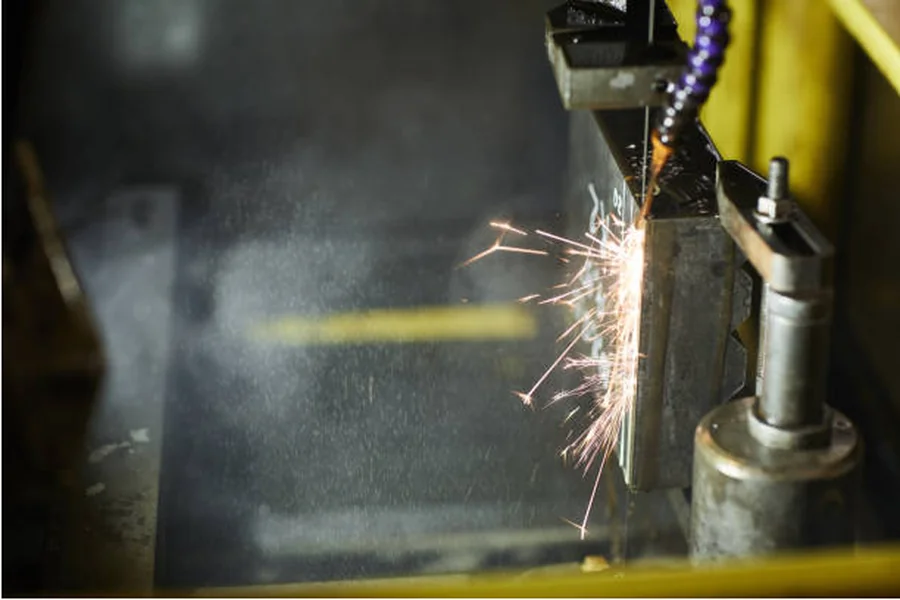
Aerospace manufacturing never sits still. Engines, flight controls, and other components keep shrinking, getting spikier, and switching to tough alloys that laugh at regular mills and lathes. As deadlines shorten and tolerances tighten, many shops are turning to wire EDM-milling wire-EDM, a non-touch process that quickly makes the tricky jigs and fixtures today’s planes and rockets demand.
OEMs, Tier 1 houses, and in-house engineering teams find EDM-support shops nearly impossible to ignore if they want to keep pace with constant innovation and razor-thin specs.
What Wire EDM Is: A Spark-Erosion Cheat Sheet
Wire Electrical Discharge Machining (EDM) is a chip-less method that trims metal by letting an electrically charged fine wire arc across the workpiece. Most important, the wire never touches the part; heat instead melts away material and leaves a mirror-finish cut. Because there are no heavy forces at play, machine tool wear drops, setups hold, and engineers can follow path codes that would bend or break a z-axis cutter long before it reaches, say, a pocket shoulder.
Wire EDM cuts with a thin, almost invisible strand of wire, which means it leaves parts with astonishing detail, ultra-smooth surfaces, and shapes that standard cutters simply can’t reach. That level of control is exactly what aerospace tooling needs-profiles so fine, kerfs so narrow, and dimensions so exact that only wire EDM delivers them on a regular basis.
Manufacturers looking for high-precision machining services quickly turn to wire EDM for:
- Making hardened dies and tools with tangled, 3-D shapes
- Keeping leftover stress and twist to a bare minimum
- Holding tolerances down to ±0.002 mm
- Delivering the same quality part after part in critical jobs
Why Aerospace Tooling Requires Uncompromising Precision
Tooling sits at the bottom of every aerospace production line. Whether a fixture that drills pinpoint holes in a fuselage panel or a die that stretches titanium into frames, each aircraft piece rests on the strength and steadiness of its tools.
Discover endless possibilities in technology with Techsslaash. Read expert opinions, tutorials, and reviews that help you explore and understand AI, mobile devices, and digital ecosystems effortlessly. Techsslaash — where modern tech meets smart learning.
Because aerospace parts fly at high speeds and under heavy stress, their tools must keep pace. That means:
- Extreme dimensions, because even a tiny slip can ground a plane.
- Parts that shrug off heat, wear, and metal fatigue.
- Cutters that work smoothly on tough metals like Inconel, titanium, and hardened steel.
- Shapes that mirror the bold lines of next-gen components.
- Consistent output after thousands of runs.
While traditional CNC machines still dominate the shop floor, they struggle with razor-thin features and hardened stock because every cut chips away at the tool. By pairing wire EDM with high-precision machining, shops can meet aerospace specs today and scale tomorrow.
The Key Advantages of Wire EDM in Aerospace Tooling
Geometric Freedom and Complexity
Wire EDM is perfect for aerospace tooling because it can slice tight corners, internal passages, and delicate profiles with zero contact. Since the process feeds a thin, electrically charged strand instead of a spinning cutter, parts emerge with square holes, sharp edges, and features traditional mills simply cannot reach.
In the aerospace world, parts are often packed with several functions into tight spaces. When the same complex shape appears in the manufacturing die, costly steps vanish and quality climbs.
Superior Accuracy and Repeatability
Wire EDM machining delivers that accuracy and repeatability long tool lives demand. Because cuts are made with tiny electrical sparks and no mechanical pressure, even thin or fragile stock bends very little.
Less bending means less rework, higher yields, and fewer line stoppages- exactly what global aerospace supply chains need.
Compatibility with Hardened and Exotic Materials
Wire EDM handles any material that conducts electricity, whether its hardened steel, titanium, tungsten carbide, or a modern superalloy. These are staple choices in aerospace because they resist heat, pressure, and rust.
Traditional machining wears fast or distorts under the strain of high-volume runs. Wire EDM sidesteps those problems and delivers tight tolerances without costly rework, specialized tools, or long lead times.
Smooth Surface Finish with Fewer Burrs
Aerospace tools have to be spot-on in size and still boast a mirror-like surface if they’re going to work right every time. Wire EDM delivers a roughness between Ra 0.1 and 0.4 μm-numbers that let mating parts slide together and bear heavy loads without a hitch.
Because the finish is so good, shops often skip extra grinding or polishing, and that keeps clearances snug from the first part to the last.
Where Wire EDM Shines in Aerospace Tooling
In today’s aircraft factories, wire EDM and other ultra-precise services show up in a range of key tool-making tasks:
Precision Dies for Sheet Metal Forming
Skin panels, stiffening ribs, and brackets usually start as tough aluminum or titanium sheets. Dies made by wire EDM copy every curve and corner perfectly and can survive the crush and the repeat cycles.
Molds for Composite Part Fabrication
Lightweight composites are taking over the skies because they save weight and add strength. Every curing mold must hold its shape under heat and pressure, and that’s where wire EDM steps in again, making inserts, locating pins, and alignment jigs with rock-solid accuracy.
Jigs and Fixtures for Aircraft Work
When crew members put a plane together, they lean on custom jigs and fixtures that hold each part steady while it gets bolted, welded, or checked. Even a tiny slip here can throw off lines that guide flight or crack the airframes strength. Wire-EDM cuts tiny keys, dowel holes and twisty shapes, letting shops build those helpers with the repeatability they live and breathe.
Tool Inserts for Engines and Turbines
Inside a jet engine, every tool faces intense heat and fast repeat cycles. Wire-EDM steps in again, crafting hardened inserts and guide plates so tight in size that parts lock together once, protecting quality through every build or overhaul.
Picking a Wire-EDM Partner You Can Trust
For aerospace makers, the choice of wire-EDM shop is as critical as the wire itself. A solid high-precision machining services team brings more than new machines; it couples savvy process engineering, sharp quality checks and a full grasp of aerospace rules.
Here are the must-have traits you should check: * ISO and AS badges that prove the shop plays by aerospace rules. * State-of-the-art measuring gear so every part gets checked in-house. * Skilled EDM pros who know how to tweak settings for peak performance. * Flexible capacity that keeps pace with prototypes and low- to mid-run orders. * Team-minded engineers ready to offer DFM tips while the tool is still on the drawing board. Clear talk, solid paperwork, and the knack for hitting tight deadlines are absolute musts in aerospace work.
Conclusion: A Strategic Advantage in Precision Tooling
As aircraft designs grow more intricate and materials harder to cut, the pressure on tooling keeps rising. Wire EDM has stepped up as a key workhorse, crafting complex, high-stability tools with a level of accuracy that hardly drifts from part to part. Pair that with dependable high-precision machining and you let shops shave setup time, slash scrap, and explore bolder layouts. Its value goes beyond a niche process-it becomes a real edge for any firm that wants to shape the future of flight.