

Introduction
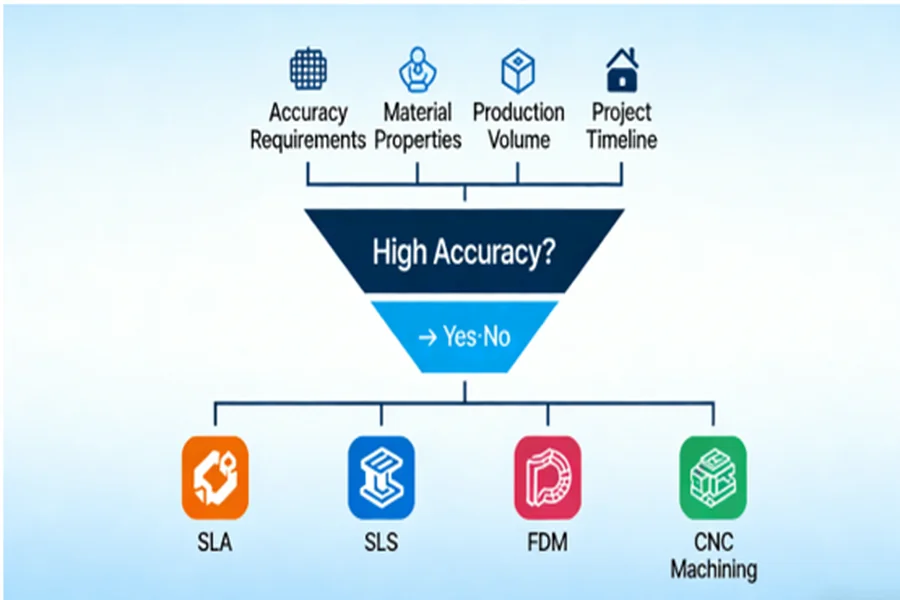
In product development, the use of inappropriate rapid prototyping strategies results in cost overrun issues. This is because technology is inadequately validated. This is due to the unavailability of knowledge on the capabilities and limitations of the technology. Technology selection influenced by experience and cost can be riskier. A scientific methodology based on accuracy of technology, material properties, the number of the produced batch, and the time required has been proposed. In the following sections, the major technologies are discussed.
What are the main differences and uses of popular rapid prototyping tools?
The skill in the realm of rapid prototyping is to realize that there is simply no technology better suited to all tasks. It is imperative to distinguish between the fundamental natures of mainstream technologies and other technologies such as SLA, SLS, FDM, and CNC Machining.
Principle fundamental technology
SLA-Stereolithography: An ultraviolet laser is used in it, that selectively cures the layers of liquid photopolymer resin. It is known for producing parts with very high resolution and really smooth surface finishes. SLS-Selective Laser Sintering: A laser sintering the powdered material-usually nylon-based-fuses it layer by layer. The great advantage is that the surrounding powder provides support to allow the creation of complex, functional geometries. FDM Deposition Modeling: It works on thermoplastic filament heating and extrusion, depositing layer upon layer. It is characterized by its low cost and operational simplicity. Computer Numerical Control/CNC Machining: The material is removed from a solid block to ultimately get a custom-designed part by moving factory tools and machinery according to the pre-programe computer software. It grants the highest material variability and mechanical properties.
A Comparative Analysis Across Key Dimensions
A comparative table is used to emphasize the different profiles for each technology based on important factors such as accuracy, mechanical properties, material variety, and cost. For example, SLA has excellent surface finish quality, but the output is brittle. SLS has good functional properties without the use of supports. However, material properties are granular. FDM is the easiest to use among all; however, its accuracy is lowest, and strength is also anisotropic. However, for high-level precision and better mechanical strength, CNC Machining Services stand out; however, cost and time for production could be high for irregular shapes.
According to the European Space Agency (ESA) in its document for additive manufacturing validation, to maintain the integrity of the validation process, the selected technology must have consistency with the manufacturing process for the final product. It is important to note that for further analysis regarding different types of rapid prototyping, this resource is also enlightening.
Aligning Technology with Project Objectives
-
When the Priority is Visual Fidelity
For prototypes where a very appealing appearance is a concern, such as presentation prototypes or ergonomic prototypes, SLA is likely the best choice because it offers the best finish.
-
When the Priority is Functional Performance
Where parts are expected to undergo mechanical, thermal, or chemical environments, better alternatives would be the strong materials offered by CNC Machining Services or the complex geometric parts offered by SLS.
-
When the Priority is Speed and Cost for Iteration
In the initial stages of the design process, where the emphasis is oriented towards quick iterations and where costs must remain minimal, FDM can be regarded as an effective method of rapid prototyping through which the functionality of basic form and fit can be validated.
How to construct a scientific framework for rapid prototyping technology selection?
Moving beyond ad-hoc decisions requires a structured, four-dimensional framework. Leading providers of rapid prototyping services use such a model to guide effective collaboration with their clients. The first dimension is that of Precision and Tolerances. The required level of accuracy dictates technology suitability. For instance, is the prototype for a visual mock-up or a precision functional test? The second dimension concerns Material Performance Needs. The prototype has to simulate the key properties of the final product. The required strength, thermal stability, or biocompatibility will reduce the material and process options significantly. The third dimension is that of Required Volume (Quantity). The number of parts needed will, as a rule, come into considerations of economic viability.
While any process can be used to make a single piece, economies of scale shift upward with increasing volumes, making technologies like vacuum casting or the manufacturing of Custom Parts via rapid tooling more attractive when the volumes become batches. The last dimension is that of the Project Timeline. The total allowable lead time, including any needed post-processing, introduces a very important constraint. This can be thought of as a type of decision tree, wherein abstract principles are changed into actionable steps. Moreover, working with a supplier who operates according to international quality standards such as ISO 9001 entails a well-documented, traceable, and reliable rapid prototyping process.
How to determine the validity of rapid prototyping material selection?
Material is an integral part of the prototype, and its selection has to be considered a decisive factor in the validity of any functional test. Expert Precision Engineering Services include guidance on material selection to ensure prototypes meet their intended purpose. Photopolymer Resins (SLA), although available in a range of properties-like standard, tough, high temperature-are generally not suitable for long-term functional testing under harsh conditions, unlike engineering thermoplastics.
Engineering Plastics from SLS or FDM-like Nylon (PA)-have good mechanical strength and good thermal resistance, making them suitable for functional prototypes that approximate the performance of injection-molded parts. CNC Machining Services for metals and engineering plastics become critical when a prototype must be exposed to the same operational environment as the final product. As the American Society for Testing and Materials, ASTM International, reveals, the importance of using standardized rapid prototyping materials ensures consistency and comparability of data. Thus, the criticality of selecting a supplier with well-documented and certified material is linked to the validation credibility.
How to achieve the optimal solution of cost and efficiency by hybrid strategy?
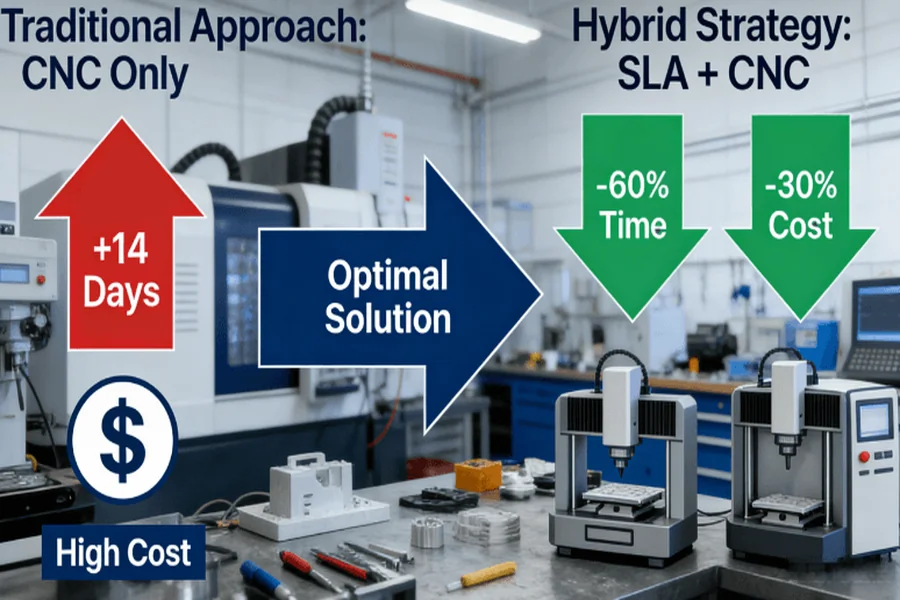
For more complex products involving several components with varying demands, a hybrid approach involving the integration of various prototype technologies may provide the best possible cost/speed/performance compromise, thus embodying a sophisticated Rapid Prototyping Solutions paradigm.
The Reasoning Behind a Hybrid Model
The strength of the strategy is being able to take advantage of the best feature of a technology for a particular component in an assembly or product. For instance, if the housing component, which is aesthetically important in a product, can be produced using the technology SLA, then the high strength components can be produced through CNC Machining Services.
Illustrative Case: Smart Device Development
A group of innovators requiring 15 prototypes for a complex product needed to perform intense testing. The traditional method of producing a CNC machined part for all components was quoted for a high price in 14 days. The hybrid technique used a SLA process for 3D printing of a complex non-loading case, CNC machining for high-strength components made of aluminum, and SLS for standard fixtures. The combined technique led to a reduced overall cost of 30% for a lead time of 5 days; a 64% relative improvement over traditional times. It is important to note that success in a project like that relies on a supplier being skilled to handle a multifaceted project.
A supplier that has high standards for certifications, for instance JS Precision whose certifications include AS9100D for Aerospace, is adequate for handling a project that has complex manufacturing using multiple processes. To make further inquiries about integrated services for a project like that, have a professional review of rapid prototyping services.
Key Factors for Successful Implementation
-
Integrated Design Planning
CAD models must be designed with the assembly interfaces of different manufacturing processes taken into consideration.
-
Project Management Excellence
It is easier to communicate with a supplier who has the capability to handle the whole process of rapid prototyping rather than involving multiple suppliers for different technologies.
How does outsourcing prototype production affect the total cost of ownership?
Whether to prototype in-house or subcontract should be determined by Total Cost of Ownership. This is because Total Cost of Ownership goes beyond the unit cost per part. In-House Costs involve the investment in prototype machinery, as well as material inventory and the cost of downtime. These amounts are substantial. However, Outsourced Service Costs make such amounts variable expenses.
Only for the capacity used must the company pay. Specialized prototype CNC machining service vendors follow the On-Demand Production strategy. This is ideal for cash flow management because substantial investment is avoided. A better rapid prototyping service vendor adds value by providing Technical Expertise, Design for Manufacturability advice that maximizes designs for cost and performance, and Quality and Reliability that come with first-rate systems.
Conclusion
Choosing the correct rapid prototyping process can have a major influence on the project risk and turnaround time. It is the need of the hour to have a scientific approach that assesses accuracy, material type, volume, and time. Get in touch with a certified manufacturing professional today to get a personalized rapid prototyping solution and an instant quote for your project.
Author Bio
The author is a senior consultant in manufacturing engineering with over a decade of experience in the field of precision manufacturing and rapid prototyping in ‘technological innovation and process optimization.
FAQs
Q1: What technology should be used for functional testing when a high level of heat resistance (>120°C) is necessary?
A1: SLS with high temperature nylon materials or CNC Machining Services with engineering materials like PEEK or metal would be recommended for use above 120°C.
Q2: Can 3D printing be considered economical for production volumes ranging between 50 and
A2: For production quantities between 50-100 units, vacuum casting or rapid tooling can provide a less expensive solution on a per-unit basis. 3D Printing is more suited to low production or very complex components.
Q3: In outsourcing, intellectual property protection is ensured through
A3: It is very important to choose an ISO 9001-approved supplier and sign an NDA. Make sure they have good data handling procedures, such as encrypted file transfer.
Q4: What is the average lead time from file to prototype?
A4: Plain SLA/FDM pieces can be delivered within 1 to 3 days, but the CNC/SLS parts take 3 to 7 days depending on the size and processing type.
Q5: Is rapid prototyping applicable for medical or aerospace validation?
A5: Yes, if the supplier has the necessary certifications (e.g., ISO 13485, AS9100D), then they are using traceable certified materials.