
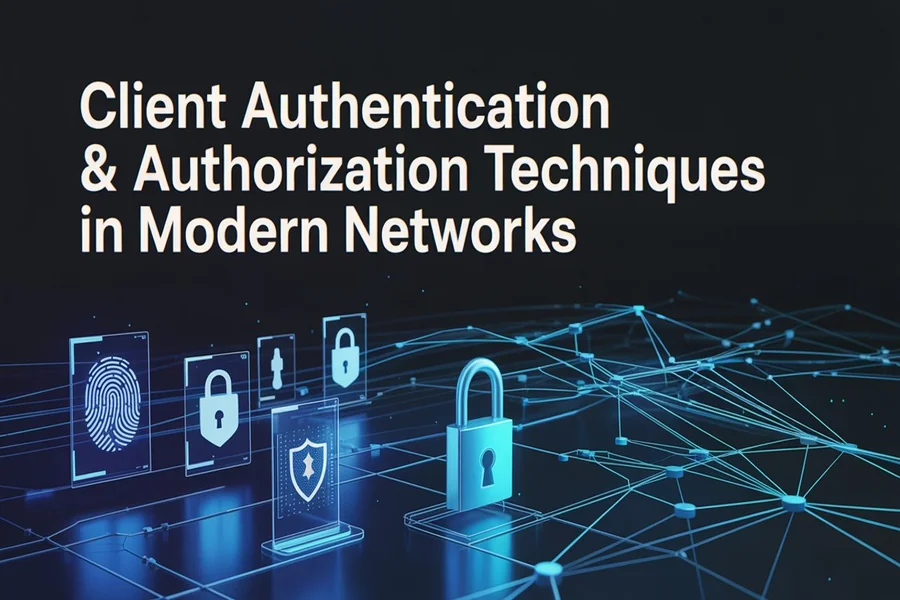
In today’s hyper-connected digital environment, securing access to enterprise resources has become more challenging than ever. Organizations now operate across distributed networks, cloud platforms, and remote work ecosystems, making identity security a core pillar of network defense. Many professionals deepen their expertise in these areas through advanced programs like CCIE Security training, which provides in-depth knowledge of authentication architectures and policy frameworks.
Modern networks must move beyond simple password checks. They need intelligent, adaptive, identity-centric systems capable of verifying not only users but also devices, locations, applications, and behavioral patterns. This blog explores the advanced client authentication and authorization techniques that secure today’s enterprise networks.
Why Authentication & Authorization Are Critical in Modern Networks
With the rise of remote connectivity, BYOD adoption, IoT expansion, and SaaS applications, enterprises face increased risks of unauthorized access, credential theft, and privilege escalation. Modern authentication systems ensure identity accuracy, while authorization defines fine-grained permissions based on role, policy, or real-time conditions.
Traditional perimeter-based security is no longer effective because users now operate outside the network just as often as inside. As a result, modern organizations rely on identity as the new security perimeter.
Modern Authentication Techniques Explained
1. Password-Based Authentication (Growingly Insufficient but Still Used)
Passwords remain the simplest authentication method, but they suffer from:
- Weak password creation
- Reuse across multiple platforms
- Brute-force and phishing vulnerabilities
Due to these risks, passwords are rarely used alone in secure modern environments.
2. Multi-Factor Authentication (MFA)
MFA adds additional layers of verification. It typically includes at least two of the following:
- Knowledge factors: password, PIN
- Possession factors: mobile OTP app, security token, smart card
- Inherence factors: biometric fingerprints, face recognition
Modern MFA tools integrate with:
- VPN access
- Cloud applications
- Remote workforce environments
- Privileged access systems
MFA dramatically reduces the risk of unauthorized entry due to compromised credentials.
3. Certificate-Based Authentication (CBA)
CBA uses X.509 digital certificates to authenticate devices or users. It is widely used with:
- 802.1X wireless networks
- VPN gateways
- ISE-based identity frameworks
Benefits include:
- Eliminates password dependency
- Hard to forge
- Integrates with PKI for large-scale deployments
CBA enables strong identity assurance and seamless device onboarding.
4. Token-Based Authentication (OAuth, SAML, JWT)
Cloud and API-driven environments rely heavily on token-based authentication.
Popular frameworks include:
- OAuth 2.0 for app-to-app permissions
- SAML for enterprise single sign-on (SSO)
- JWT (JSON Web Tokens) for stateless API authentication
Tokens offer:
- Temporary, revocable authentication
- Secure access across distributed apps
- Support for Zero Trust workflows
5. Biometric Authentication
Biometrics provide high-assurance identity validation. Examples include:
- Fingerprint scanning
- Iris recognition
- Facial matching
- Voice authentication
These methods are widely adopted in mobile devices and corporate identity systems due to their accuracy and resistance to replication.
Modern Authorization Techniques in Enterprise Networks
Once authentication confirms identity, authorization ensures that the right level of access is assigned.
1. Role-Based Access Control (RBAC)
RBAC assigns access based on predefined user roles such as :
- Administrator
- HR staff
- Guest
- Finance department
RBAC simplifies permission management but lacks flexibility for dynamic environments.
2. Attribute-Based Access Control (ABAC)
ABAC uses attributes—such as job title, device type, location, or time of day—to determine access rights dynamically.
Example attributes:
- User attribute: Department = HR
- Device attribute: Posture = Compliant
- Environment attribute: Location = Corporate office
ABAC is ideal for enterprises with complex security requirements.
3. Policy-Based Access Control (PBAC)
PBAC uses highly granular rules that consider:
- Network risk level
- User identity
- Security Group Tags (SGTs)
- Device compliance status
- Real-time telemetry
Cisco ISE and TrustSec rely heavily on PBAC to enforce dynamic authorization policies across wired, wireless, and VPN connections.
4. Zero Trust Authorization
Zero Trust is based on never trust, always verify. It requires continuous authentication and authorization throughout a session.
Key Zero Trust principles include:
- Micro-segmentation
- Identity-based enforcement
- Device health verification
- Least-privilege access
Zero Trust ensures attackers cannot move laterally even if they breach one part of the network.
Authentication vs Authorization Techniques
| Category | Technique | Strength Level | Primary Use Case |
| Authentication | MFA | High | Remote login, cloud services |
| Authentication | Certificates | Very High | Wireless 802.1X, VPN, corporate endpoints |
| Authorization | RBAC | Medium | Structured enterprise access |
| Authorization | ABAC | High | Dynamic, identity-driven environments |
| Authorization | Zero Trust | Very High | Segmented, secure enterprise networks |
How NAC Enhances Authentication & Authorization
Network Access Control (NAC) platforms such as Cisco ISE, Aruba ClearPass, and Fortinet NAC significantly strengthen access security by combining identity verification with device posture assessment.
NAC solutions can:
- Enforce 802.1X authentication
- Validate device health (antivirus, OS version, patches)
- Assign users to VLANs dynamically
- Push downloadable ACLs (dACLs)
- Apply session-based policy enforcement
- Integrate with firewalls, SIEM, and endpoint security systems
NAC is the foundation of identity-driven network security in modern enterprises.
Conclusion
As enterprise networks evolve toward cloud-native, identity-centric, and remote-access environments, advanced authentication and authorization techniques have become essential. MFA, certificates, tokens, and biometrics strengthen the verification process, while RBAC, ABAC, PBAC, and Zero Trust ensure precise and adaptive access control. Implementing these methods helps organizations maintain compliance, minimize attack surfaces, and safeguard sensitive data. For professionals aiming to master these concepts, especially in identity-based networking and policy enforcement systems, CCIE Security remains one of the most valuable certifications. In conclusion, building a strong authentication and authorization strategy is critical for securing the modern enterprise landscape.