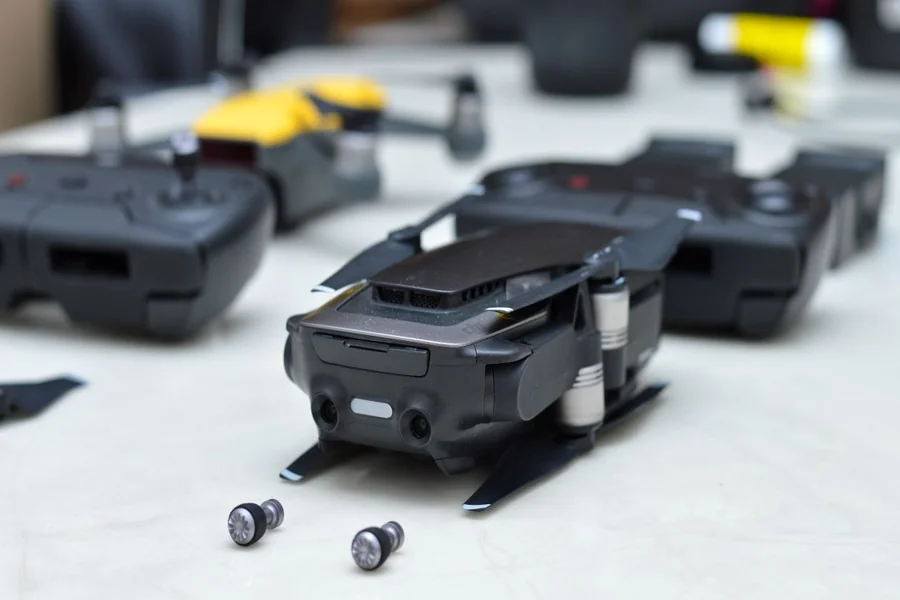
Agricultural drones are quietly changing the way modern farms get work done.
Activities that once required hours of manual scouting, helicopter flyovers or boots-on-the-ground inspections can now occur in minutes. What’s more, the technology available in these aircraft is only improving each year – getting smarter, faster, and more powerful.
Here’s the thing…
Drones are still perceived by many people as high-end toys. But modern professional agricultural drones offer cutting-edge tech capable of:
- Scan entire fields in minutes
- Spot crop stress before it spreads
- Apply pesticides with pinpoint accuracy
- Map thousands of acres in a single flight
Pretty cool, right?
Time to break it all down.
Here’s what’s coming up:
- Why Drone Technology Matters Right Now
- The Core Tech Inside Professional Drones
- 5 Features Setting Modern Drones Apart
- Choosing The Right Drone For The Job
Why Drone Technology Matters Right Now
The numbers tell the story.
According to Grand View Research, the global agricultural drones market size was $3.37 billion in 2025 and is expected to reach $21.59 billion by 2033:
That’s enormous growth — and it’s going to accelerate.
Why? Farms are expanding. Labour is scarce. Pressure to produce more food with less input continues to increase.
Professional agricultural drones solve all three problems at once.
However, not just any drone will suffice. If you’re conducting commercial work (especially in regulated industries) you’ll need drones that have passed rigorous supply chain and security standards. NDAA-compliant drones are the choice of serious commercial operators who can’t risk using compromised drones out in their fields, on their pipelines, or at their job sites (agricultural businesses, inspectors, public safety organizations).
Consumer adoption of compliant & secure drone tech will occur rapidly. It’s the underlying technology that makes drones attractive purchases anyway.
The Core Tech Inside Professional Drones
What separates a $300 hobby drone from a $30,000 professional one?
It all boils down to what is inside. Cracking open the hood reveals what’s going on.
Advanced Sensor Arrays
Modern professional drones aren’t just cameras with propellers.
They carry multiple sensor types — sometimes all on a single flight:
- Multispectral sensors for crop health analysis
- Thermal cameras for spotting irrigation issues
- LiDAR for 3D mapping and elevation models
- RGB cameras for high-resolution visual data
Every sensor has its strengths. Fuse them together and you can see everything going on on the ground – things the human eye would never see.
This could be particularly important for agricultural drones. Multispectral imagery can show farmers precisely which parts of their fields are stressed days or weeks before they can see it with the naked eye.
AI and Machine Learning Onboard
This is where it gets interesting…
Today’s drones don’t just gather data. Many can analyse it on-board using embedded artificial intelligence. So if a drone spots a diseased plant, it can record its GPS coordinates and upload that information directly into a treatment algorithm while still in-flight.
McKinsey & Company reports that AI farming operations can boost crop yields 10 to 20% while reducing inputs by up to 15%.
That’s a serious return on a single piece of equipment.
GPS and RTK Positioning
Standard GPS gets you within a few meters.
Professional drones have RTK (Real-Time Kinematic) positioning that is accurate down to a centimetre. That’s what makes spray drones so accurate: they can fly over the exact same crop row repeatedly without drifting into a neighbour’s field.
Whether it’s for farms, construction or surveying jobs, that kind of precision isn’t a luxury. It’s a requirement.
5 Features Setting Modern Drones Apart
Not every industrial strength drone is created equal. These 5 specs are what you should compare when shopping for your operation.
1. Flight Time and Battery Tech
Older drones gave you 15 to 20 minutes of flight time.
Today’s commercial drones fly 45+ minutes. Hybrid models are even breaking the one hour barrier. All this adds up to greater coverage per flight, fewer battery changes, and less time off the clock.
2. Payload Capacity
Spray drones for agriculture now carry 40 to 70 litre tanks.
Mapping drones have interchangeable payloads for different sensors. The ability to mount different equipment on the same airframe has made professional drones much more versatile.
3. Obstacle Avoidance
Modern drones use computer vision and ultrasonic sensors to detect:
- Power lines
- Trees
- Buildings
- Other drones in the air
It makes flying in cluttered spaces much safer — and greatly eliminates costly collisions.
4. Secure Data Transmission
Data security is a big deal in 2026.
Commercial drones today will feature encrypted data links to ensure that sensitive agriculture data, infrastructure maps or inspection video doesn’t fall into the wrong hands. This will be especially crucial for commercial drone operators working on government contracts or sensitive infrastructure.
5. Modular Design
The best professional drones are built to be repaired and upgraded.
Swap motors. Swap cameras. Update firmware. Modular design like that means your drone investment can last years, rather than dying in 12 months.
Choosing The Right Drone For The Job
So how do you pick the right drone for your operation?
Begin by deciding what you need it to accomplish. Jobs have vastly different requirements:
- Crop scouting: lightweight drone with multispectral camera
- Spraying: heavy-lift drone with large payload capacity
- Mapping: fixed-wing or hybrid drone for big area coverage
- Inspection: quad-copter with zoom camera and thermal sensor
Don’t get talked into buying more drone than you actually need.
But also…
Don’t skimp, either. There is nothing more useless than a drone falling out of the sky mid-mission. Not only does it cost time, but it ruins your data and creates safety hazards.
A drone is just a tool. Choose one that’s suitable for the job, complies with regulations you need to comply with, and is made by a company that will support the product in the future.
Bringing It All Together
The technology inside today’s professional agricultural drones is genuinely impressive.
Whether it’s AI-assisted crop scouting or centimetre-level accurate spray applications, drones have gone from being a “nice to have” to being table stakes for how modern businesses operate.
To quickly recap:
- The market for these tools is growing fast and won’t slow down
- Sensor tech, AI, and RTK positioning are doing the heavy lifting
- Compliance, security, and modular design matter for long-term value
- Pick the drone that fits the job, not just the lowest price tag
Flying drones are taking farming, surveying and inspections into the future. Smarter. Safer. More capable than ever before.