
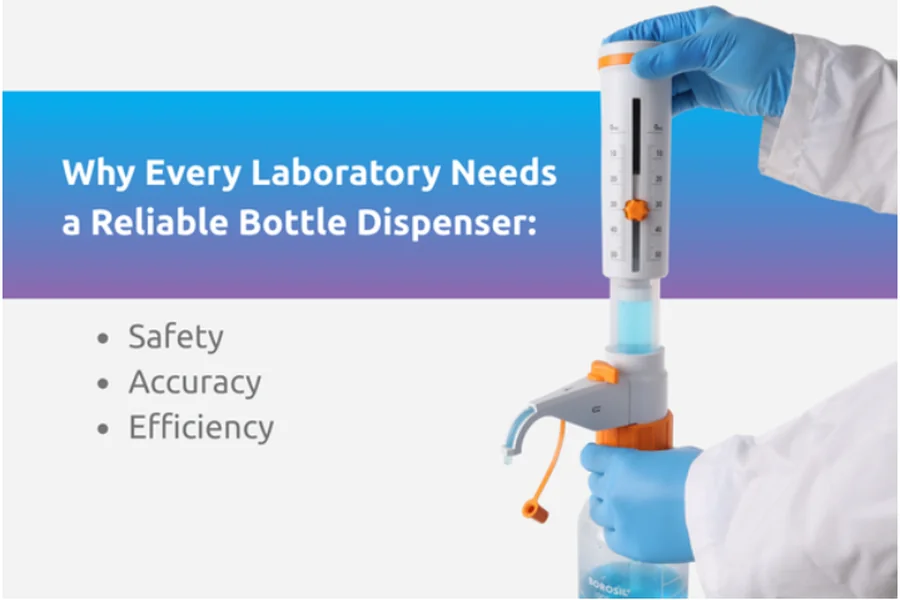
Laboratory dispensers are core instruments where consistent, accurate, and contamination-free liquid transfer is essential. For researchers, QC chemists, and technicians working hazardous chemicals, a calibrated dispenser for bottle-mounted workflows significantly reduces error margins in facilities that deal with high-throughput tasks, manual pour-offs, or unregulated dispensing, which present unacceptable risks. Volumetric deviation, chemical loss, and operator exposure can derail validated methods.
Bottle top dispensers are purpose-built to address these constraints. They maintain accuracy within ISO 8655-5 limits and allow gravimetric traceability when recalibrated using distilled water and standard balances.
Design Variants Supporting Critical Lab Functions
The LabQuest range from a premium laboratory equipment manufacturers like Borosil Scientific, for example, includes two variants for laboratory use. Both are available in six volume ranges, from 0.25 mL to 100 mL.
| Specification | Research Model | Pinnacle Model |
| Calibration | DIY Calibration Ring | DIY Calibration Ring |
| Dispensing Volume | 0.25–100 mL | 0.25–100 mL |
| Recirculation Valve | Not Included | Included |
| Bottle Adapters | 28, 32, 36, 38, 40, 45 mm | Same |
| Wetted Materials | Borosilicate Glass, PTFE, PFA, FEP | Identical |
| Splash Protection | Built-in Safety Guard | Built-in Safety Guard |
| Working Position | 360° Rotatable | 360° Rotatable |
These variants feature a manual, positive-displacement design that ensures durability against mechanical fatigue and chemical wear. They function efficiently without the need for batteries, digital interfaces, or heating elements.
Material of Construction and Chemical Compatibility
Components that come in direct contact with liquids in both models are constructed using:
- Borosilicate glass for the piston barrel, offering inertness and clarity
- PTFE/PFA/FEP linings for chemical resistance
The dispenser is suitable for many acids, bases, and solvents, except for restricted chemicals such as hydrofluoric acid, HCl above 40%, HNO₃ above 70%, explosive or suspension-forming liquids, and those that attack PP caps. Borosilicate and fluoropolymer contact surfaces maintain tolerance across a broad pH and temperature range.
A chemical compatibility chart is accessible via a QR code on the dispenser body. This provides lab users with instant access to approved reagent lists before each procedure.
Calibration: Gravimetric Protocol per ISO 8655-5
Volume consistency should be verified after dismantling, barrel cleaning, or autoclaving, depending on the frequency of use, media viscosity, and post-autoclaving requirements. Both variants include a DIY calibration ring with a position indexing scale (0–20) for direct visual reference.
Gravimetric Testing Process
- Set Volume: Nominal or commonly used volume
- Dispense: 10 full strokes using Type II deionised water at 20 °C
- Weigh: Use a calibrated balance with 0.1 mg readability
Once done, you can calculate based on:
| Parameter | Formula |
| Mean Weight (g) | (w1 + … + w10) / 10 |
| Mean Volume (mL) | Mean Weight × Z-Factor |
Z-Factor is temperature-dependent; e.g., 1.0025 at 20.0 °C. Compare the result against the dispenser set volume and adjust using the calibration knob:
- Clockwise = decrease
- Anti-clockwise = increase
Once adjusted, mark the new zero on the calibration ring. Repeat the process post-disassembly or barrel cleaning. Calibration charts should be maintained according to the lab’s SOP.
Safety Engineering Built into Dispenser Structure
Unregulated dispensing can lead to reagent wastage, exposure, and measurement drift. The LabQuest units of Borosil Scientific, for example, incorporate:
- Safety Splash Guard: Prevents vertical discharge in case of plunger slip
- Secure Discharge Assembly: Locked fit to prevent tube ejection
- Ergonomic Handle: Supports right- or left-handed use
- 360° Bottle Rotation: Avoids repositioning of hazardous bottles during adjustment
The recirculation valve recovers pre-fill solution back to the reservoir, reducing solvent loss during priming. This is especially valuable for high-cost solvents, such as HPLC-grade methanol or mobile phase buffers.
Adapter Versatility for Cross-Bottle Usage
The dispenser fits industry-standard bottles with neck sizes from 28 mm to 45 mm.
| Neck Size | Typical Use |
| 28 mm | Analytical reagents |
| 32 mm | Pharmaceutical solutions |
| 36 mm | Volatile organics |
| 38–45 mm | High-volume reserve bottles |
Adapters are chemically resistant and mechanically stable under rotation, preventing cross-threading or leaks. This compatibility reduces the need for multiple dispensers.
Operational Guidelines for Optimal Accuracy
To maintain volume precision, you need to follow these specifications:
- Do not use below or above rated capacity (0.25-100 mL only)
- Avoid viscous suspensions unless validated
- Clean immediately after use with acid/base-sensitive reagents
- Always autoclave at 121 °C and 15 psi for 15–20 minutes. Disassemble the unit and unlock the volume knob before autoclaving. Recalibrate afterwards.
End-of-Line Checkpoints
Some of the most important things you need to keep in mind include;
| Checklist Item | Frequency |
| Volume Verification | Recommended after autoclaving, dismantling, or as per lab SOP. |
| Seal Inspection | Monthly |
| Discharge Tube Check | Per Use |
| Adapter Threading | Per Use |
| Chemical Re-evaluation | Quarterly |
Conclusion
Reliable dispensing contributes to traceability in assays and production batches. The LabQuest series from Borosil Scientific features a durable manual design that enables quick accuracy checks after autoclaving, without depending on digital systems. This helps pharmaceutical and analytical labs maintain NABL-certified standards while conveniently verifying instrument performance between official calibrations.
These dispensers are engineered for manual excellence. Labs prioritising gravimetric accuracy and operational safety will benefit from integrating these variants into the routine workflow. For material certifications, operating ranges, and compatible media, you can refer to the Borosil Scientific catalogue or request the current COA set via authorised distribution.