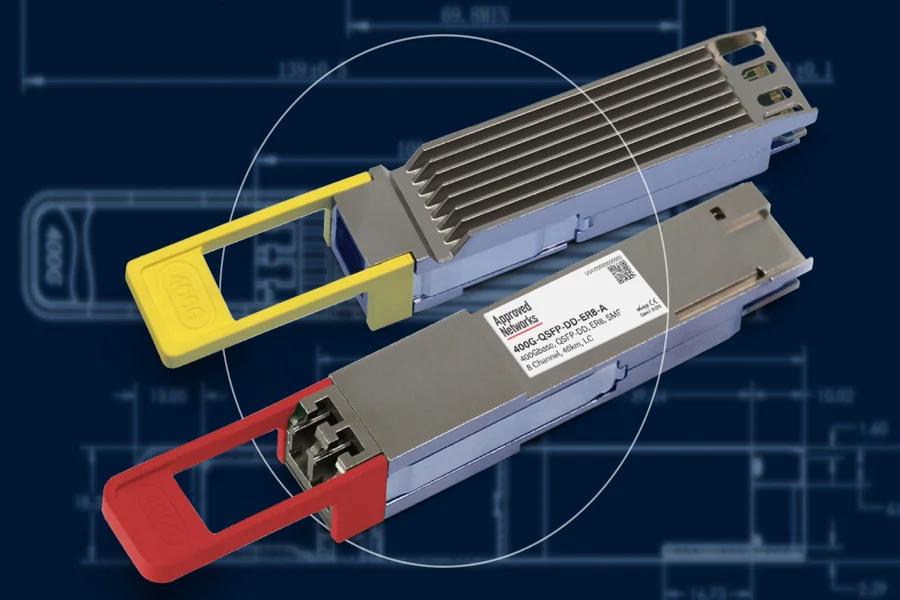
The 400G OSFP optical transceiver is a next-generation high-speed module designed to support 400-gigabit Ethernet transmission in modern data center and high-performance computing environments. OSFP, short for Octal Small Form Factor Pluggable, is optimized for higher power dissipation and signal integrity compared with earlier form factors, making it well suited for 400G and future 800G applications.
A typical 400G OSFP module integrates eight electrical lanes on the host side and supports various optical architectures such as DR4, FR4, or LR4, depending on transmission distance and network design. With data rates of up to 53 Gbps per lane using PAM4 modulation, these modules enable massive bandwidth scaling while maintaining acceptable power efficiency. As hyperscale data centers continue to expand east-west traffic and AI workloads demand lower latency and higher throughput, the 400G OSFP has become a key building block in next-generation network infrastructure.
Key Features and Technical Characteristics of 400G OSFP Modules
One of the most important advantages of the 400G OSFP form factor is its thermal capability. Compared to QSFP-DD, OSFP modules typically support higher power budgets, often up to 15 W or more, which allows the integration of advanced DSPs and optical components. This enhanced thermal headroom improves signal performance and long-term reliability in dense switch environments.
From a technical perspective, 400G OSFP optical transceivers rely on PAM4 modulation to double the data rate per lane without doubling the bandwidth. Advanced digital signal processing compensates for dispersion, noise, and channel impairments, enabling stable transmission over single-mode fiber. Depending on the module type, transmission distances can range from 500 meters for DR4 to 2 km for FR4 and up to 10 km for LR4 variants.
OSFP modules also support hot-pluggable operation, standardized electrical interfaces, and management via I2C with digital diagnostic monitoring. These features simplify deployment and maintenance while allowing real-time monitoring of temperature, voltage, bias current, and optical power. As a result, network operators can maintain high availability and quickly identify potential issues before they impact system performance.
Typical Applications and Deployment Scenarios
400G OSFP optical transceivers are primarily used in high-density leaf-spine architectures within hyperscale and cloud data centers. In these environments, they serve as high-speed interconnects between spine switches, aggregation layers, and core routers. The high bandwidth density of OSFP modules allows network designers to reduce the number of physical ports while significantly increasing total switching capacity.
Another major application area is artificial intelligence and high-performance computing clusters. AI training workloads generate massive east-west traffic between GPUs and compute nodes, placing extreme demands on network throughput and latency. 400G OSFP modules help meet these requirements by providing fast, low-latency optical links that scale efficiently as cluster sizes grow.
Telecom and service provider networks are also beginning to adopt 400G OSFP technology for data center interconnect and metro aggregation use cases. As traffic volumes continue to rise due to cloud services, video streaming, and emerging AI applications, 400G optical solutions offer a future-proof path that balances performance, power consumption, and operational cost.