
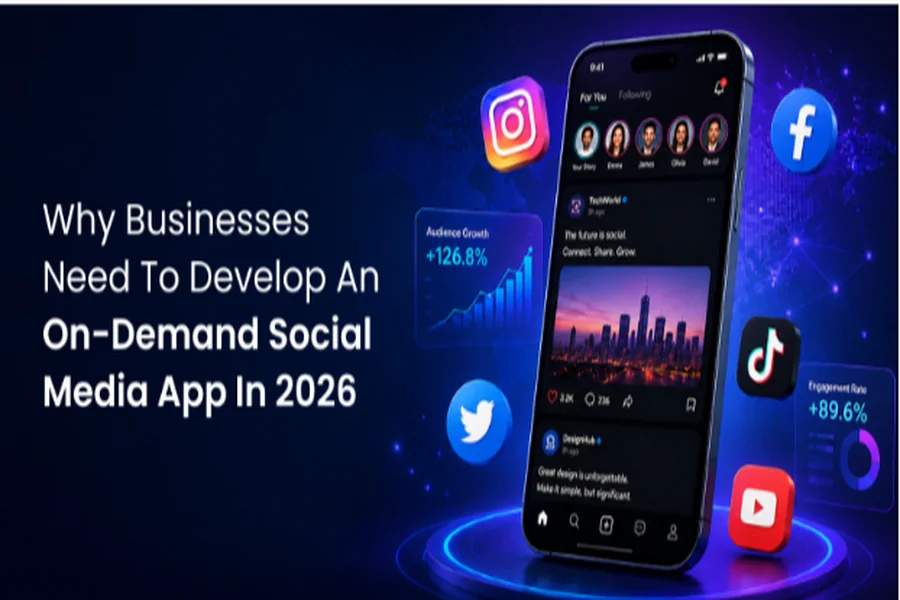
Social media stopped being a marketing channel a while ago. In 2026, it’s where people shop, learn, build communities, and decide which brands deserve their money. The problem for businesses is that on rented platforms, Facebook, Instagram, and TikTok, the algorithm owns your audience, not you. One policy change or reach drop, and years of community building can go away quickly.
That’s the gap that on-demand social media app development fills. Instead of competing for attention on someone else’s platform, businesses are building their own: niche communities, creator platforms, interest-based networks, and branded social spaces where they control the experience, the data, and the revenue. This blog looks at why that shift is accelerating in 2026, what the market numbers say, how AI has changed what these apps can do, and how to pick a development partner who won’t waste your budget.
The Growing Market for On-Demand Social Media Apps
The audience keeps expanding. According to DataReportal’s April 2026 figures, there are now 5.79 billion social media user identities worldwide, nearly 70% of the planet, and the average user spends around two and a half hours on social platforms every day. That is an immense, still-growing pool of daily attention.
The money follows the attention. Statista projects global social media ad spending to reach roughly $317 billion in 2026, while social commerce keeps pulling a bigger share of online sales as users buy directly inside apps instead of clicking out to websites.
Here’s the part that matters for businesses: users are fragmenting. People increasingly split their time across six or seven platforms, and niche communities for fitness, gaming, parenting, local services, and professional networks keep pulling users away from the big general-purpose feeds. Nobody is going to outbuild Instagram. But a focused social app serving one audience extremely well? That space is wide open, and it’s where most successful new social products now launch. This growing shift is creating new opportunities for businesses to explore on-demand social media app development and build platforms tailored to specific user communities.
Why Businesses Should Invest in an On-Demand Social Media App in 2026
On-Demand Social Media App Development helps businesses build stronger customer relationships while reducing dependence on third-party social platforms. By owning the platform, user engagement, customer data, and monetization are more under the control of businesses. These are four good reasons why it is a wise business decision to invest in it in 2026.
Better Customer Engagement
On your app, you are not fighting an algorithm for reach. Push notifications, community features, live sessions, and direct messaging put your brand in front of users daily on your terms. Communities built within a branded app also prefer to stay active longer, as the space feels like theirs, not just another feed shouting for attention.
Multiple Revenue Opportunities
A social app is not one product; it’s a collection of revenue streams. Subscriptions, in-app purchases, creator monetization tools, advertising, sponsored content, and social commerce can all live inside the same platform. More on this topic is provided below, as it deserves its own section.
Access to Valuable Customer Insights
On third-party platforms, the platform keeps the behavioral data and sells you a summary. On your app, first-party data on what users watch, share, buy, and abandon flows directly to you. In a world of tightening privacy rules and disappearing third-party cookies, owned first-party data has become one of the most valuable assets a business can hold.
Competitive Advantage
Most businesses in any given niche still rely entirely on rented social channels. Launching a dedicated community app puts real distance between you and competitors: switching costs rise, loyalty deepens, and your brand becomes the place where the community lives instead of one voice inside someone else’s crowd.
AI Is Transforming Social Media Apps in 2026
AI has quietly become the difference between social apps that grow and apps that stop working. Recommendation engines now personalize feeds from a user’s very first session, which directly improves retention, the metric that kills most social products. AI moderation filters spam, hate speech, and harmful content at a scale no human team could match, keeping communities safe enough for advertisers and families.
On the creation side, built-in AI tools help users generate captions, edit video, translate posts, and even produce content from prompts, which lowers the barrier to posting and keeps feeds active. And AI-driven analytics tell platform owners which features drive engagement and which quietly push users away. In 2026, on-demand social media app development without an AI layer is building yesterday’s product.
Revenue Opportunities for Businesses
A properly designed on-demand social app can be monetized in several ways at once:
| Revenue Model | How It Works |
| Subscriptions | Premium tiers with exclusive content, features, or ad-free access |
| In-app purchases | Virtual gifts, boosts, profile upgrades, and digital goods |
| Advertising | Native ads and sponsored posts are sold directly to relevant brands |
| Social commerce | In-app, in-store, where users buy without leaving the app |
| Creator monetization | Revenue sharing with creators, with the platform taking a percentage |
| Data-driven services | Partner insights, aggregated and privacy-compliant |
The best apps usually start with one or two models and add the others as the community grows. Trying to monetize everything on day one is a reliable way to scare off early users before the network effect comes in.
How to Choose the Right Social Media App Development Company?
The partner you pick will matter as much as the idea itself. A capable on-demand social media app development company should be able to show you the following:
- Live social or community apps in app stores, not mockups; actual products with users
- Feeds, chat, and notifications at scale are hard engineering problems; infrastructure for real-time experience
- In-house AI capabilities, including recommendations, moderation, and analytics
- Security and compliance knowledge, including GDPR and regional data protection laws
- Post-launch support, because social apps live or disappear on a regular schedule after release
Ask uncomfortable questions early: How do you handle a feed for a million users? What’s your moderation approach? Who owns the code? Teams with broader on-demand app development experience bring another advantage: they’ve already solved matching, real-time updates, and payment flows in other industries, and those patterns transfer directly to social platforms.
Conclusion
The case for building in 2026 depends on ownership. Audiences on rented platforms can be limited, taxed, or lost; an audience on your app is an asset that compounds. With nearly 5.8 billion people on social media, users splitting into niche communities, and AI making sophisticated features affordable for mid-sized budgets, the barriers that once protected the big platforms have never been lower. Businesses that invest in on-demand social media app development now, with a clear niche, a realistic monetization plan, and the right development partner, are building the customer relationships their competitors will be renting for years.
FAQs
Q1. What is an on-demand social media app?
Basically a social platform you build for your target audience. Feeds, profiles, chat, plus on-demand things like live sessions or instant matching baked in.
Q2. Why should businesses build a social media app in 2026?
Attention now lives on social platforms. A dedicated app can help a business create a loyal community, learn from its users, and develop new sources of income outside the traditional channels.
Q3. What are the must-have features of a social media app?
Any effective social app is based on user profiles, real-time chat, push notifications, content feeds, likes and comments, search, privacy controls, and smooth media sharing.
Q4. How much does social media app development cost?
Somewhere between $40K and $150K, plus or minus. A lean MVP sits at the low end. Add AI, live streaming, and commerce, and the bill goes up fast.
Q5. How long does it take to develop a custom social media app?
It takes 3-4 months for a typical simple app to develop. Designing, developing, testing, and launching a fully featured custom app takes anywhere from 6 to 9 months.