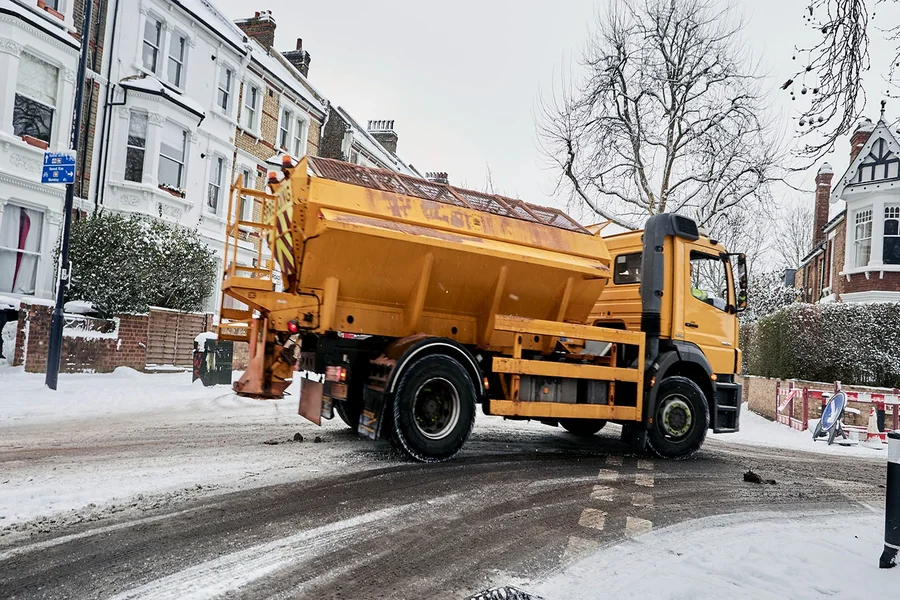
Maintenance of roads during winter is a crucial task of municipalities and property managers in the areas of excessive snow and ice. The safety of drivers and pedestrians highly rely on the way the roads are treated in icy situations. Two of the most common materials are salt and sand and can be used to fight slippery floors, yet they must be used at the right time and in the right manner. The knowledge of the distinction between their roles, constraints, and optimal practices would make roads safe and minimize wasteful expenditures and environmental effects.
The Role Of Salt In Ice Control
One of the best tools that can be used in melting ice on roads is salt. When properly used it reduces the freezing point of water and assists in the breaking of the bond between the ice and the pavement. This will allow plows to clear the snow more easily, and will limit the snow that is packed up and can last weeks without treatment. The trick of using salt is to use the right quantity at the right time, especially before a big freeze, when it can serve to ensure that the ice does not attach to the road surface.
Salt is however not the ideal solution. Salt is somewhat useless in extreme low temperatures, below approximately fifteen degrees Fahrenheit. In these instances, most road crews are turning to other options such as liquid de-icer or road salt brine that can work in lower temperatures and much faster. A combination of these treatments using salt gives the greatest efficiency and ensures that the roads are clear and safe even in severe winter weather.
The Role Of Sand In Winter Road Safety
Sand is not a fusing medium, but a gripping material. It is especially useful when the temperatures are too low so that salt could not perform its work. The sanding of icy roads provides more grip to the drivers and this reduces skid and accidents. This renders sand a very important substance in extremely cold climates where removal of ice through use of chemicals is not enough. Sand is also cheap and easily accessible hence, it can be used as a sure way of getting traction in a hurry.
The difficulty of sand is that it does not actively ice or snow-hose. It instead gives short term safety advantages until the time when conditions would be cured. This is the reason why it is usually taken as an addition to salt, but not as a full remedy. It is possible to combine the two materials so that the roadways are treated as well as to be made safer to be used immediately by vehicles and pedestrians.
Combining Salt And Sand For Best Results
Salt and sand are used to be the best combination in icy conditions. Salt also helps melt the ice, whereas sand helps it on its way. This mix minimizes the occurrence of accidents and the road crews can slowly get the pavement clear. There are two reasons why this two-fold method should be used in the regions where the freeze and the thaw are regular. The first one is the adequate safety and the second one is the durable maintenance in the long run.
One more advantage of mixing sand and salt is that it allows reducing the material usage. Rather than using great quantities of salt, which are detrimental to the environment, a lesser amount can be used with sand to offer the same melting and traction properties. With the help of this strategy, it is easier to achieve a balance between safety, cost efficiency and environmental responsibility. Road maintenance personnel are also known to vary the proportion of salt to sand based on the conditions on the ground to have the best possible outcome in any given situation.
Timing And Application Techniques
The timing of salt and sand application is also important with regard to performance. It can be sprayed with salt in advance of a storm or as soon as the snow falls and the ice will not fuse to the road, thus making it easier and quicker to clean. This is more efficient than waiting till the thick ice is formed. Roads or other liquid de-icer solutions can also be pre-treated with salt brine for roads; the treatments are evenly spread and thus they work fast once the precipitation begins.
Instead, sand is to be used when the surfaces already are slick and hazardous. It is most convenient on hilly terrain, crossways, and highways where it is important to have the traction at once. Sand can be easily dispersed by passing traffic and therefore it might have to be replenished more frequently than salt. Constant checking of the road conditions enables the crew to change applications depending on weather conditions and patterns of use.
Practical And Environmental Concerns
Whereas salt and sand are efficient, they are also associated with environmental and practical difficulties. Too much salt may ruin vegetation, rust automobiles and pollute water flows. On the same note, sand is able to block the drainage channels and clean up during spring. On this account, responsible use is needed to have a balanced road safety and environmental protection. Selecting the material that is appropriate to the conditions and utilizing only the necessary one reduces the adverse effects to a minimum and makes the roads safe.
Communities are progressively seeking options to decrease the use of the usual materials at the cost of safety. New liquid de-icer products, blended treatments and better application equipment are also enabling road crews to work more efficiently. Through proper analysis of weather conditions, traffic movements and the resources at hand, the municipalities can make the right judgements on how to handle the icy roads but at the same time ensure that the environment is not damaged in the long run.
Conclusion
Salt and sand are not going to lose their importance as a tool to be used to maintain roads in winter, yet they must be applied appropriately and the roles of these tools should be clearly understood. Salt is a better melting agent and sand gives traction when the weather is too cold or during winter when there is too much ice to treat. When merged, they provide short-term and long-term control of the ice. Road solutions like liquid de-icer or salt brine can be added to further increase results. Using these materials properly and responsibly, road crews will be able to maintain roadsway safety in winter, save money and minimize the environmental impact.