
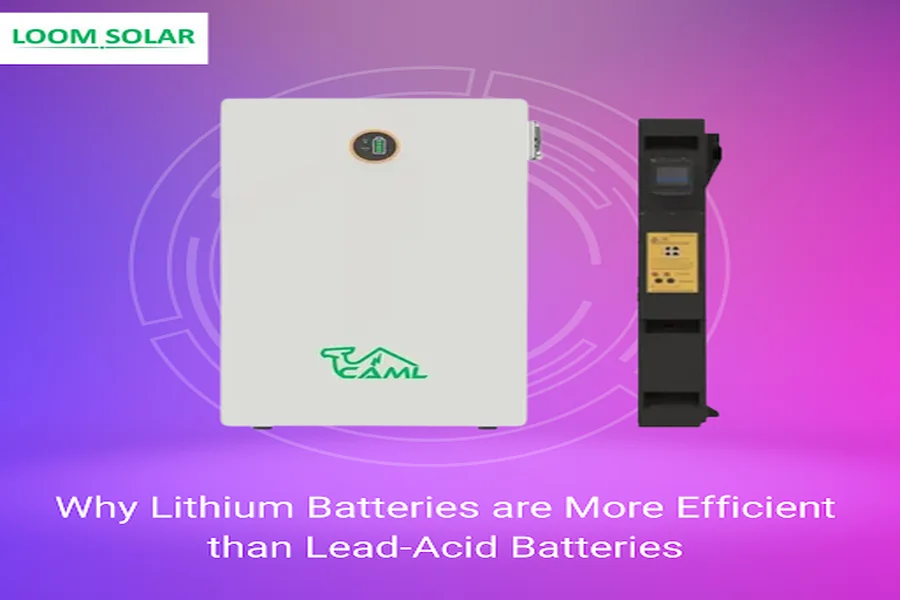
As energy needs continue to grow in households, businesses, and industries, choosing the right battery technology has become increasingly important. Lithium batteries and lead-acid batteries are two of the most popular possibilities among the numerous others. While lead-acid batteries have been around for over a century, lithium batteries are now becoming the preferred choice due to their efficiency, performance, and long-term benefits. But why exactly are lithium batteries more efficient than lead-acid batteries? Let’s explore in detail.
Understanding Battery Efficiency
Battery efficiency refers to how effectively a battery can store and release energy. When electricity is fed into a battery, a certain amount is lost as heat during charging and discharging. As efficiency rises, less energy is wasted. This suggests that consumers can obtain more usable power for the same quantity of energy.
For families using solar energy or businesses running backup systems, battery efficiency directly impacts electricity costs and energy independence.
-
Depth of Discharge (DoD)
The depth of discharge of lithium batteries is one of their greatest benefits over lead-acid batteries.
- Lithium batteries: Up to 80–90% of the lithium battery’s capacity can be depleted without harming it.
- Lead-acid batteries, on the other hand, should not be discharged beyond 50% if you want to maintain their lifespan.
This means a lithium battery provides far more usable energy than a lead-acid battery of the same size. For example, a 10 kWh lithium battery can safely deliver 8–9 kWh, while a 10 kWh lead-acid battery will only give you about 5 kWh.
-
Energy Efficiency
Lithium batteries have a round-trip efficiency of around 90–95%, which means they can return up to 95% of the energy stored in them. Lead-acid batteries only achieve about 70–80% efficiency.
In simple terms, if you charge both batteries with 1,000 units of electricity:
- The lithium battery gives you back 900–950 units.
- The lead-acid battery gives you back only 700–800 units.
This difference adds up over time, especially for households relying on solar power for homes or businesses with high energy needs.
-
Lifespan and Cycle Life
Another indicator of efficiency is how many cycles of charging and discharging a battery can withstand before its capacity begins to deteriorate.
- Lithium batteries typically last for 3,000–6,000 cycles or more, which translates to 10–15 years of use.
- Lead-acid batteries usually last only 500–1,000 cycles, or about 3–5 years.
This longer lifespan makes lithium batteries more cost-efficient in the long run, even if their upfront price is higher.
-
Charging Speed
Another efficiency factor is how quickly a battery can be charged.
- Lithium batteries support fast charging and can often be charged to 80% in just a couple of hours.
- Lead-acid batteries require slower charging to avoid damage and can take 8–12 hours to fully recharge.
For families dealing with frequent power cuts or businesses needing reliable backup, faster charging is a major advantage.
-
Size and Weight Efficiency
Lithium batteries are much lighter and more compact than lead-acid batteries for the same amount of energy storage. You can store more energy in a smaller area due to this increased energy density.
For example:
- A lithium battery pack storing 5 kWh might weigh 30–40 kg.
- A lead-acid battery system of the same capacity could weigh 100 kg or more.
This makes lithium batteries ideal for homes with limited space, as well as for electric vehicles and portable devices.
-
Maintenance Requirements
Efficiency is not only about energy but also about time and effort.
- Lithium batteries are maintenance-free and come with built-in battery management systems (BMS) that regulate performance and safety.
- Lead-acid batteries often require regular maintenance, such as checking electrolyte levels and cleaning terminals.
This difference makes lithium batteries more user-friendly and dependable in the long term.
Real-World Impact
For a family using a 5 kWh solar battery system:
- A lithium battery can deliver around 4.5–4.8 kWh of usable energy daily for over 10 years.
- A lead-acid battery may only deliver 2.5–3 kWh of usable energy daily, and it will likely need replacement within 4–5 years.
Over 10–12 years, this results in far greater savings, reduced hassle, and better energy independence with lithium batteries.
Conclusion
While lead-acid batteries are cheaper upfront, their low depth of discharge, shorter lifespan, and poor efficiency make them less reliable for long-term use. Lithium batteries, with their higher energy efficiency, longer cycle life, faster charging, and low maintenance, clearly stand out as the smarter choice for modern households and businesses.
In a world where reliable and sustainable energy is becoming essential, investing in lithium batteries ensures not only better performance but also long-term financial and environmental benefits.