Introduction
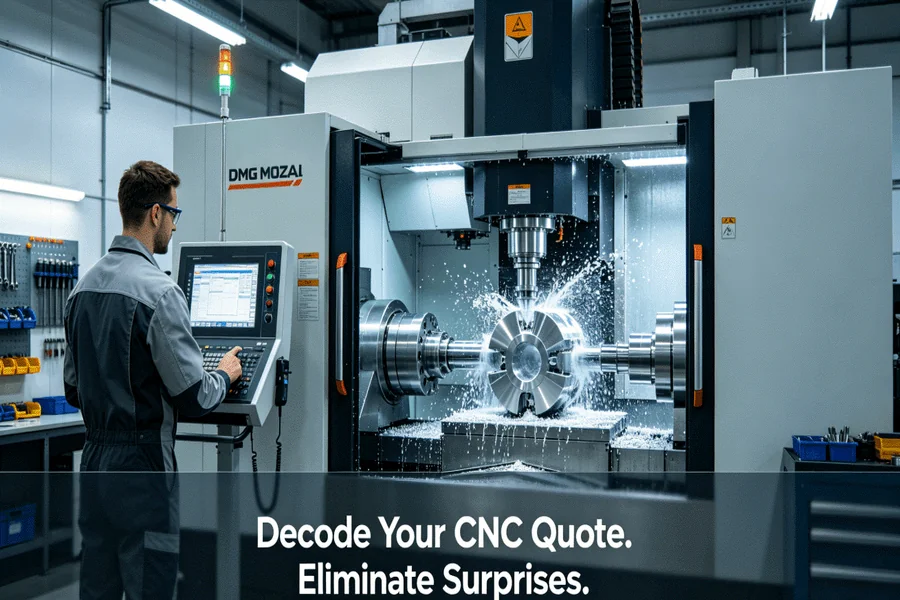
In the area of custom parts purchase, one of the issues that continues to puzzle many companies is why quotations for CNC machining services of parts appear to be so diverse among various manufacturers despite seeming equivalence of the items in question. A misleadingly low quotation turns out to be a precursor to possible cost escalation or delivery delay problems. The central issue here is associated with the information disadvantage and ignorance of production processes. A common practice of price comparison typically concentrates on unit price alone without taking into account such important factors as Design for Manufacturing (DFM) and strength of quality assurance systems.
This article will present a detailed explanation of the reasoning used when preparing a CNC machining quotation. A step-by-step guide is provided in order to achieve reliable and comparable quotations.
Why Do Quotes for Seemingly Simple Parts Vary So Widely Between Factories?
A part that looks straightforward on paper can receive wildly different CNC machining quotes. The fundamental reason is that the unit price is rarely equivalent to the total cost of ownership. A responsible quote represents the price of a complete solution, and variations arise from several key factors.
First, the choice of machining strategy directly impacts cost. A part that might be forced onto a 3-axis machine may require multiple setups, increasing labor and potential error.The vendor could be recommending a five-axis option, which, although more expensive in terms of machine hour rates, finishes the job in one go with greater accuracy in case of complicated designs. This explains why there is a disparity in the first quotes issued.
Secondly, the source of materials used can explain some differences in pricing. If the quote considers aerospace-grade aluminum from a reputed mill and ensures that it is certified and traceable through its Mill Test Report, it will have a very different costing than an uncetified quote. Trusted CNC service providers, consider material reliability and complete traceability in their quote, making it highly reliable but costly too.
Finally, the stringency of default standards is a hidden battlefield. What are the unspecified tolerances per ISO 2768? What is the default surface finish? A supplier quoting based on tighter internal standards for inspection and finish will inherently have higher costs than one applying the broadest acceptable limits. Therefore, a transparent and reliable CNC machining quote should be based on detailed process analysis, not just a superficial reading of the drawing.
How to Lock in Controllable Costs at the Design Stage for CNC Machining on Demand Projects?
In CNC machining on demand projects, approximately 80% of the final cost is determined during the design phase. Proactive DFM is the most powerful tool for cost control, preventing expensive manufacturing compromises down the line.
Optimizing Part Geometry for Efficiency
Difficult-to-machine features drastically increase time and cost. Excessively thin walls risk vibration and scrap, while very small internal radii force the use of fragile tools at slow feed rates. Proactively optimizing these geometries—by increasing wall thickness and specifying larger corner radii within functional limits—enables faster, more stable, and more reliable CNC machining production, directly reducing the CNC machining quote.
Strategic Design and Collaboration for Cost Control
Effective cost management extends beyond simple geometry to the overall design strategy and partnership model. Two interrelated approaches are fundamental.
- Design to Avoid High-Cost Processes
A single, highly complex part may necessitate expensive 5-axis or EDM work. Strategically redesigning it as multiple simpler components for assembly often allows for more efficient 3-axis custom precision machining, slashing both cost and lead time.
- Leverage Early Supplier DFM Analysis
The most significant savings begin before the RFQ. Engaging a manufacturing partner during the design phase provides critical DFM insights. An expert can suggest modifications that maintain function while simplifying production, paving the way for an optimized final design and a more predictable
How Do Evaluation Priorities Differ Between Low Volume and High Volume CNC Machining Suppliers?
The requirement of low volume CNC Machining (prototyping, bridge manufacturing) and high volume CNC Machining (manufacturing in large quantities) are essentially dissimilar. Choosing the wrong supplier according to the requirement of volumes can be disastrous.
When dealing with low volumes, agility and flexibility are crucial. The supplier should be responsive, able to make quick programming and setups. A diverse portfolio of materials available in house is required for the production of multiple types of prototypes. The capability of dealing efficiently with ECNs is vital. In this scenario, speed, responsiveness, and technical assistance as an extension of the R&D team matter more than marginal savings in unit costs.
On the other hand, when dealing with high volumes, stability and consistent quality come first. The company must have highly automated CNC production lines with strong process control system to produce thousands of parts all exactly alike. Stable supply of raw materials is important in this scenario. Economies of scale in fixing, tooling and buying materials will determine total costs of the project.
The top companies often excel at serving both customer groups. Dedicated fast response team for prototypes and automated production lines for high volumes may be found among leading providers. The buyer needs to know what he/she is looking for from the start: fast and adaptable or stable and cost-effective.
How to Evaluate a Supplier’s Invisible Quality Assurance Systems Through a Quote?
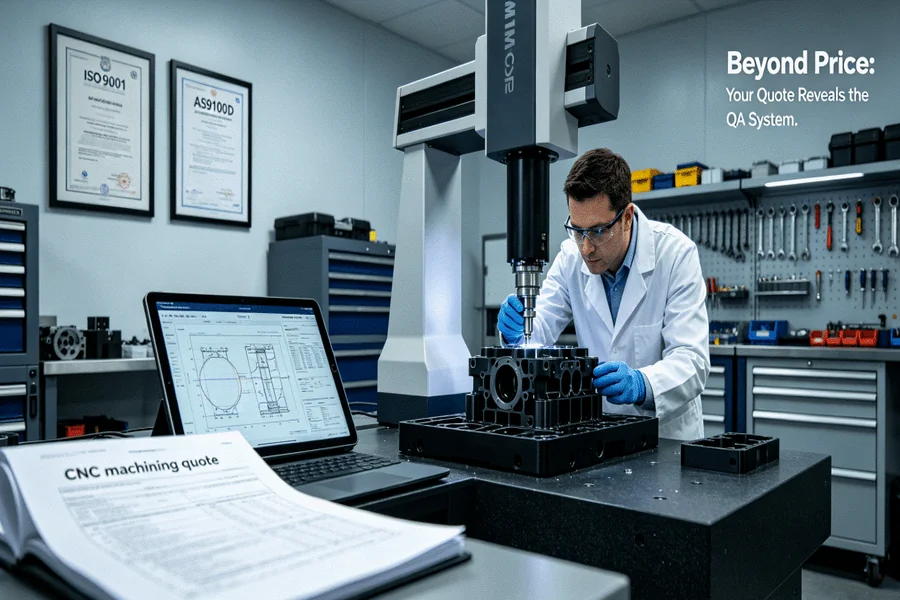
A detailed Comprehensive CNC Machining Services and Capabilities is a window into a supplier’s Quality Assurance Systems. A robust system requires upfront investment—a cost of quality that is a valuable long-term investment, preventing defects and avoiding costly rework, delays, and field failures.
First, scrutinize the quoted or attached quality plan. The proper supplier should include inspection points to be followed, such as FAI, the frequency of IPQC, and sampling frequency for final inspection. The supplier may mention the use of CMMs for checking critical dimensions. These tasks each have a person assigned to them and require the use of time and equipment; therefore, the cost of these processes can be incorporated into the comprehensive estimate. An estimate that includes the machining cost with generic quality terms is high-risk.
Second, the completeness of quality documentation indicates system maturity. Does the quote include or offer as line items Material Certification Reports, FAI Reports, or Final Inspection Reports? A supplier with an ingrained system provides these as standard deliverables, as they are the natural output of their process. If these reports carry a high extra cost or are unavailable, it suggests a procedural gap.
This can be evaluated directly through looking for internationally recognized certification. If the supplier has ISO 9001, IATF 16949, or AS9100D certifications, that means they have put in place a well-documented management system that continues to improve. While they may not offer the cheapest CNC machining quote, their reliable prices and deliveries tend to reduce the overall cost of ownership by reducing administrative costs and risks.
What Three Key Delivery Questions Should Be Confirmed with a Supplier Before Final Decision?
Beyond technical and price evaluations, three final delivery-focused questions must be clarified before selecting a partner. This shifts the evaluation from assessing a quote to vetting a reliable collaborator.
Confirming Lead Time and Expedite Scenarios
A quoted lead time must be the full door-to-door timeline, encompassing all stages from material procurement to shipping. It is crucial to inquire about expedited options. Understanding the available time compression and its associated cost premium is essential for effective project contingency planning. A transparent supplier will clearly outline these variables.
Establishing Processes for Changes and Issues
Clear, documented procedures for communication and problem resolution are hallmarks of a reliable partner. Two key protocols must be established upfront.
- Communication and Change Management
Define the primary point of contact and the formal process for drawing clarifications or engineering changes. A mature supplier utilizes a standard Engineering Change Notice (ECN) process, detailing the timeline and cost impact assessment for any modifications.
- Post-Delivery and Non-Conformance Policy
Clarify the policy for handling defects found upon receipt. A reliable partner will clearly state their resolution process (rework, replacement, credit), expected response time, and responsibility for associated costs, demonstrating a true commitment to quality and partnership. Choosing a supplier that offers end-to-end support, such as those providing , often leads to a more secure and manageable project outcome.
Conclusion
Securing an accurate and reliable CNC machined parts quote involves far more than comparing unit prices. It is a systematic process that begins with design, is influenced by handcraft choices, and culminates in a thorough evaluation of a supplier’s quality systems and delivery reliability. By mastering this methodology—from employing DFM to lock in costs, to understanding the cost drivers behind different processes, and finally discerning the hidden strengths within a CNC machining quote—procurement professionals transform from passive price-takers into active managers of project cost and risk. This disciplined approach is fundamental to the success of any custom precision machining project.
Author Bio
The Author works as an expert consultant in precision manufacturing having more than 15 years of professional experience in manufacturing, especially focusing on optimizing the supply chain and reducing procurement costs along with improving parts quality for manufacturers. The Author is connected to JS Precision which is ISO 9001, ISO 13485 and IATF 16949 Certified for their Custom Manufacturing Solutions.
FAQs
Q: Which documents should be prepared for quotation on CNC machining services?
A: Detailed 2D drawings with dimensions and tolerances are usually required, along with 3D CAD models (STEP file or IGES format). Information about materials used, surface finishing requirements, and quantity estimates will assist in giving an appropriate quotation.
Q: Is the price of each item always higher for CNC machining in low volume compared to high volume?
A: Usually yes, as the fixed costs associated with programming, setting up, and calibrating the machine will be distributed among fewer items. However, efficient product design using DFM can substantially lower the unit cost of CNC machined products in low volume.
Q: How do I know if my CNC machining service provider has a credible quality management system?
A: You may ask about any quality certifications held (ISO 9001), inspecting equipment, and the quality management process. It is practical to request some documentation samples regarding quality control of previous projects.
Q: What do standard tolerances in quotes mean? And what about tighter tolerances?
A: Standard tolerances usually imply something along the lines of ISO 2768-mK tolerance class for metallic components. In case tighter tolerance values are required, it is necessary to indicate it in the quotation. Suppliers adjust their process parameters and testing according to the requirement which may affect quotation itself and delivery lead time.
Q: What else apart from the machining operation would go into a quote?
A: Other common items that might be included apart from machining services in a quote may include: extra cost for specific tooling (where it requires unique tooling), cost for specially designed fixtures, charge for MTR (material test report) and any surface finishing or certification.