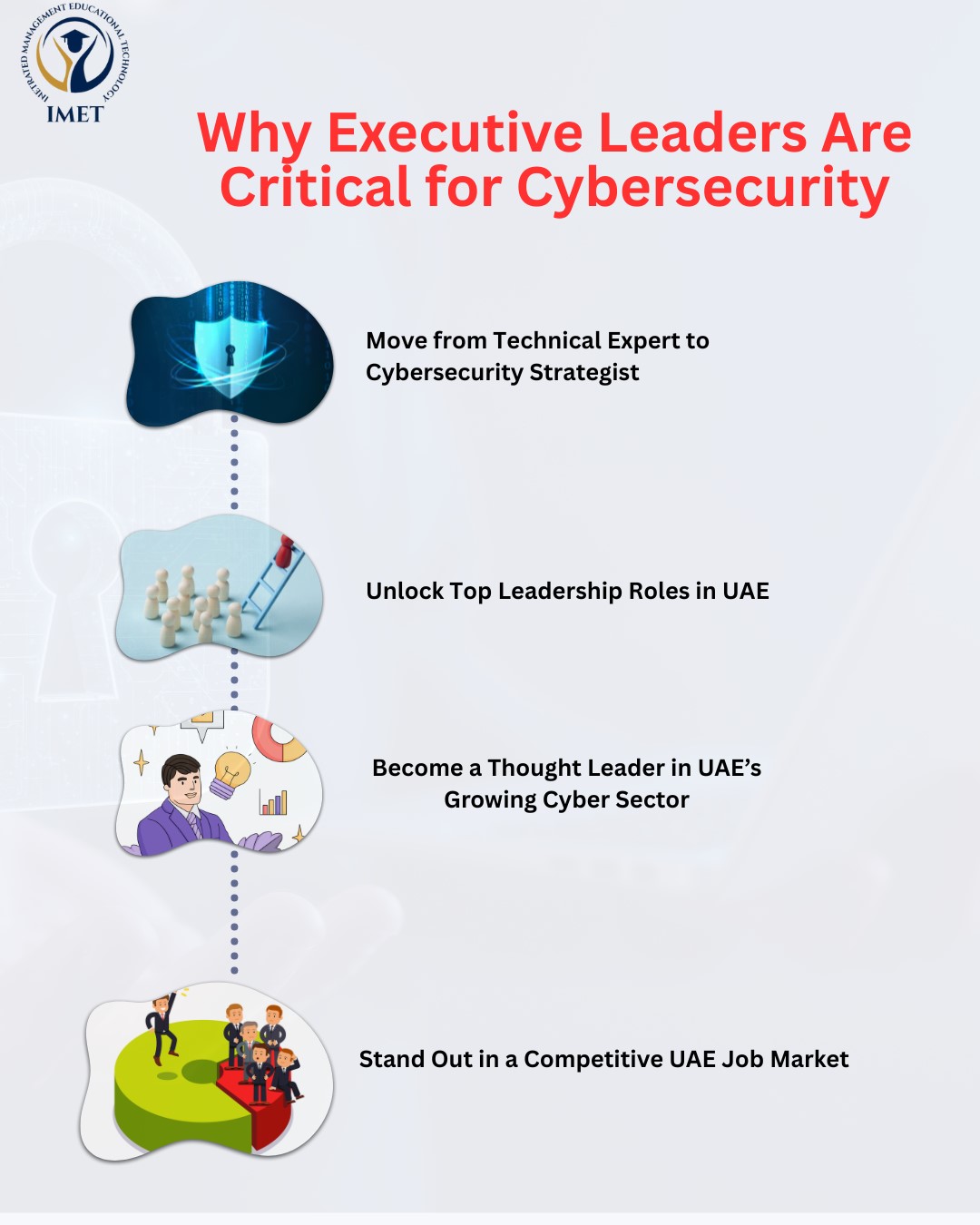
The accelerated digitalization of the United Arab Emirates includes the governance services, financial processes, and state infrastructure, as well as smart-city programs. This digitalization has increased the need to have effective leaders in the sphere of Cybersecurity. With growing levels of sophistication in cyber threats, organizations across the Emirates now require executives with a technical understanding of risk. They also require executives with expert insight into the strategic, regulatory, and economic implications of defending digital ecosystems.
An applied doctorate in Cybersecurity (or DBA in Cybersecurity) program at IMET Worldwide would provide a set of strategic and analytical skills to senior professionals. This skillset would enable them to guide resilience at the national level and cyber strategy at the board level.
Why Does Cybersecurity Now Depend on Executive Leadership?
Days when Cybersecurity issues were addressed by technical teams only are in the past. The UAE regulatory bodies include the Telecommunications and Digital Government Regulatory Authority (TDRA), the UAE Cybersecurity Council, and industry-specific agencies. These bodies now place senior leadership on the hook regarding cyber preparedness, incident reporting, risk alignment, and the maturity of compliance.
Organisations need leaders who are able to create strategic responses to the threats into business strategy, business-level governance and long-term resilience planning.
A globally accredited online DBA program in Cybersecurity equips senior managers, CXOs, and IT leaders with the executive competencies required to:
- Define cyber strategy linked to organisational value and UAE regulatory expectations
- Lead enterprise-wide security transformation programmes
- Oversee cyber governance, investments, and performance metrics
- Influence national policy, digital trust frameworks, and cross-sector collaboration
- This executive orientation differentiates IMET Worldwide’s programme from purely technical certifications.
Career Trajectories: From Practitioner to Thought Leader
Senior executives pursuing IMET Worldwide’s globally recognised online DBA program often transition into high-impact leadership roles. These roles require skills like strategic thinking, research capability, and policy influence.
From Manager → CISO / CIO / CTO (Enterprise Cybersecurity Leader)
Core responsibilities
- Enterprise-wide Cybersecurity strategy and risk appetite.
- Align cybersecurity investments with business objectives and ROI.
- Report cyber posture and metrics to the board and executive committee.
- Lead cross-functional teams (IT, legal, HR, operations) during incidents and change programs.
Skills built via DBA Program
- Translating technical risk into business language and capital allocation proposals.
- Building and supervising security program KPIs (MTTR, MTTD, risk exposure).
- Designing incident escalation and crisis governance models.
From Security Specialist → Cybersecurity Strategist (Governance & Long-Term Systems)
Core responsibilities
- Architecture of governance and design policies that instil security in business processes.
- Set and manage Business Continuity Plans (BCP), and Disaster Recovery Plans (DRP).
- Lead threat modeling and enterprise-wide control rationalization.
Skills built via DBA Program
- Advanced threat & vulnerability economics (prioritization frameworks).
- Designing measurable control frameworks and continuous assurance programs.
- Leading multidisciplinary teams to operationalize government (ops, contracts, and law).
From Consultant → Global Advisor (Thought Leader & Strategic Consultant)
Core responsibilities
- Assist government, global companies, and industry groups with their cyber strategy, rules, and new threats.
- Take the lead on projects that span borders, like coordinating foreign incidents, forms of public-private partnerships, and setting standards.
- Publish policy papers, white papers, and research with practical recommendations.
Skills built via DBA Program
- Rigorous research design, publication and dissemination (SCOPUS/IEEE readiness).
- Creating advisory frameworks that link technology, policy, and economics.
- Building influential networks through alumni, industry and government engagement.
From Team Leader → Policy Maker (Standards, Law & National Strategy)
Core responsibilities
- Draft and influence cyber law, regulatory guidance, and sector-specific standards.
- Translate technical realities into enforceable policy and compliance regimes.
- Design oversight and audit approaches for public infrastructure and critical services.
Skills built via DBA Program
- Framing technical constraints into clear, enforceable regulations.
- Leading cross-sector consultations and evidence-based policymaking.
- Quantitative and qualitative evaluation of policy efficacy.
Advanced Cybersecurity Tool Mastery Built Into the DBA Program
During the IMET Worldwide’s Applied Doctorate in Cybersecurity, leaders are trained to work with the full spectrum of modern cyber protection technologies. These technologies are used across enterprise and government environments. They will learn how to develop security measures using next-generation firewall and intrusion-detection ecosystems, SIEM platforms, endpoint defence suites, and IEM frameworks.
- Firewalls & IDS/IPS: IT leaders learn to deploy and tune platforms like Palo Alto, Snort and Suricata for network defence.
- SIEM Systems: They learn to use Splunk, QRadar and ArcSight to build real-time monitoring and event-correlation capabilities.
- Endpoint Security: They configure enterprise-level protection with CrowdStrike, Symantec and McAfee across large device fleets.
- Encryption & PKI: They also get the knowledge of applying OpenSSL and Vault to enforce secure key management and encrypted communication.
- Vulnerability Scanning: They learn to conduct enterprise audits using Nessus, Qualys and OpenVAS to identify and prioritise risks.
- IAM Frameworks: They are also taught to implement secure identity controls with Okta, Azure AD and Ping Identity to govern access across systems.
Why does IMET Worldwide’s Applied DBA Stand Out in the UAE?
IMET’s programme is built for seasoned professionals seeking to elevate their impact from operational execution to strategic leadership. Key advantages include:
- Executive-centric curriculum aligned with UAE and GCC cyber governance expectations
- Research-based decision-making capability, enabling leaders to influence policy and enterprise strategy
- Flexible online format, designed for mid-senior professionals balancing leadership roles
- Application-oriented learning, ensuring doctorate research in business administration directly improves real-world organisational outcomes
- Global academic credibility, supporting pathways into advisory, C-suite, and policy-level roles
As a result, the Applied DBA program of IMET Worldwide is one of the few programs that combine cyber knowledge with executive management. It’s a crucial overlap in the fast-developing digital environment of the UAE.
Conclusion: Lead Resilience, Lead Growth
Cybersecurity is now becoming indispensable to national competitiveness and corporate sustainability in the United Arab Emirates. Companies need leaders who can predict the emergent threats, influence the structure of governance and lead extensive reform. IMET Worldwide has dedicated an Applied Doctorate in Cybersecurity to provide senior executives with strategic, analytical, and policy-oriented skills. This program is designed to be the driving force behind a new era.
By training leaders who can connect technology, business value, and national policy, IMET prepares professionals to not only protect their organisations—but to strengthen the UAE’s wider digital future.
Author Bio :
*Dr. Trilok Singh*
PhD in Management | Leadership & Organizational Growth Advisor | Academic Mentor
Dr. Trilok Singh holds a doctorate in Management and brings a wealth of experience guiding senior professionals and business leaders. His areas of focus include strategic management, organizational behavior, leadership transformation, and business innovation.
As an educator and mentor, Dr. Singh blends academic theory with real-world leadership insights to help professionals elevate their impact. He has supported countless executives in navigating change, building high-performing teams, and driving transformation across industries.