
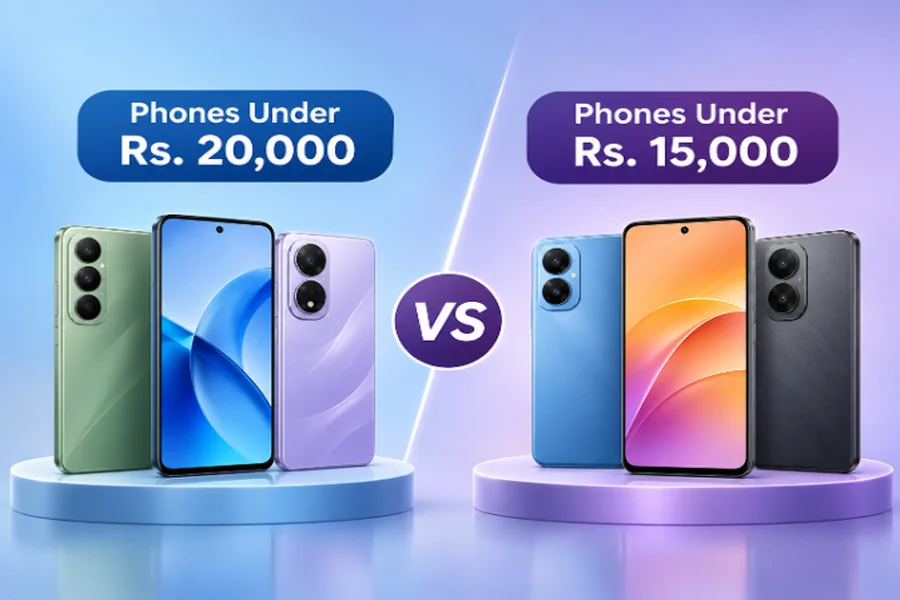
Compare phones under Rs. 15,000 and Rs. 20,000 by performance, display, camera, battery and software to see what the extra Rs. 5,000 really gets you.
If you are choosing a phone under Rs. 20,000, the biggest question is not whether you can spend the extra Rs. 5,000. You need to know what that additional budget actually changes. Phones under Rs. 15,000 already offer 5G, high-refresh-rate displays and large batteries, while moving towards Rs. 20,000 can bring better processors, AMOLED displays, improved cameras, faster charging and stronger overall hardware.
You can purchase your preferred mobile phone at a highly competitive price, thanks to limited-time offers and discounts at Bajaj Finance partner stores. Browse models on Bajaj Mall, compare processors, RAM, storage, cameras, displays and battery specifications, and visit any of the 1.5 lakh+ partner stores across 4,000+ cities. With an Easy EMI Loan of up to Rs. 5 lakh and repayment tenures ranging from 3 to 60 months, you can split the cost into manageable monthly instalments. Select models also come with a zero down payment offer, reducing your payment burden.
Which phone should you choose under Rs. 15,000 or Rs. 20,000?
Your choice should start with what you expect from the phone. A buyer who mainly uses social media, streaming and everyday apps may find a phone under Rs. 15,000 sufficient, while a buyer who games regularly or wants a better display and camera may benefit from spending more.
| Budget | Best suited for | What you get |
| Under Rs. 15,000 | Everyday use and budget-conscious buyers | 5G, high-refresh-rate displays, capable processors and large batteries |
| Rs. 15,000 to Rs. 20,000 | Buyers wanting stronger overall hardware | Better processors, AMOLED displays, improved cameras and faster charging |
| Around Rs. 20,000 | Gaming, photography and longer-term use | More capable hardware and fewer compromises across key features |
The price difference does not automatically improve every feature. A Rs. 20,000 phone may have a better processor and display but a similar battery capacity to a Rs. 15,000 model, so you should compare the areas that matter most to you.
Should you stay under Rs. 15,000 for everyday use?
Phones under Rs. 15,000 can be a practical choice if your usage mainly involves messaging, social media, streaming, calls and light gaming. Models such as the POCO M7 Pro 5G and TECNO Pova 7 5G show how much hardware is now available at this price point.
Choose this range when you want the essentials without stretching your budget. However, moving closer to Rs. 20,000 can give you a more noticeable improvement in processing power, camera hardware or overall display quality, depending on the model.
When does the extra money improve performance?
Performance is another area where the higher budget can become useful. A stronger processor can help when you switch between several applications, play demanding games or keep your phone for several years.
However, phones around Rs. 18,000 to Rs. 20,000 can offer stronger overall combinations of processor, RAM, storage and display. You should therefore compare the complete configuration rather than assuming that every phone closer to Rs. 20,000 will be faster.
How do you compare phones under Rs. 15,000 and Rs. 20,000?
The easiest way is to match the additional spending with the feature you care about most.
| Your priority | Budget to consider | Why |
| Everyday apps and 5G | Under Rs. 15,000 | Capable hardware for common tasks |
| AMOLED display | Around Rs. 15,000 to Rs. 20,000 | More options for premium-looking screens |
| Gaming | Around Rs. 15,000 to Rs. 20,000 | Stronger processor and display combinations |
| Photography | Around Rs. 15,000 to Rs. 20,000 | More models with OIS and improved camera hardware |
| Long-term use | Around Rs. 20,000 | More room for stronger hardware and storage |
A common mistake is spending Rs. 5,000 more simply because the higher-priced phone appears to offer more specifications. If you mainly use social media, streaming and messaging, you may not notice the difference in processing power.
The opposite mistake is choosing the cheapest option when you regularly play demanding games, take photographs or use your phone for several hours every day. In these cases, spending more on the right hardware can make the phone more comfortable to use over time.
Which phone should you choose by budget?
Your budget can narrow the range, but your usage should remain the deciding factor.
| Example mobile phone | Starting price | Best suited for |
| Samsung Galaxy M17 5G | Rs. 14,795 | Everyday use and camera features |
| POCO M7 Pro 5G | Rs. 14,999 | Gaming and entertainment |
| TECNO Pova 7 5G | Rs. 14,999 | Gaming and high-refresh-rate display |
| Redmi Note 15 5G | Rs. 18,999 | Display, camera and everyday performance |
| Samsung Galaxy F70 5G | Rs. 19,999 | Display and camera versatility |
Last updated: November 2026
Prices may vary by configuration, offer period and availability. Check the latest price and specifications before purchase.
Smart Savings Calculator
The Smart Savings Calculator from Bajaj Finance can help you understand potential savings by considering applicable dealer, brand and scheme offers. This can be useful when comparing phones across the Rs. 15,000 and Rs. 20,000 price ranges.
Why buy with Bajaj Finance?
- Browse and compare online: Explore mobile phone models on Bajaj Mall and compare processors, RAM, storage, cameras, displays and battery specifications before visiting a store.
- Visit partner stores: Check shortlisted models at Bajaj Finance partner stores and get expert guidance from in-store representatives.
- Opt for Easy EMI Loan: Finance up to Rs. 5 lakh with tenures of 3 to 60 months. Zero down payment is available on select models.
- Check eligibility online: Verify your pre-approved limit using your mobile number and OTP on the Bajaj Finance website.
The extra Rs. 5,000 can give you a better display, stronger performance, improved camera hardware or a more balanced overall configuration, but the upgrade depends on the model.