
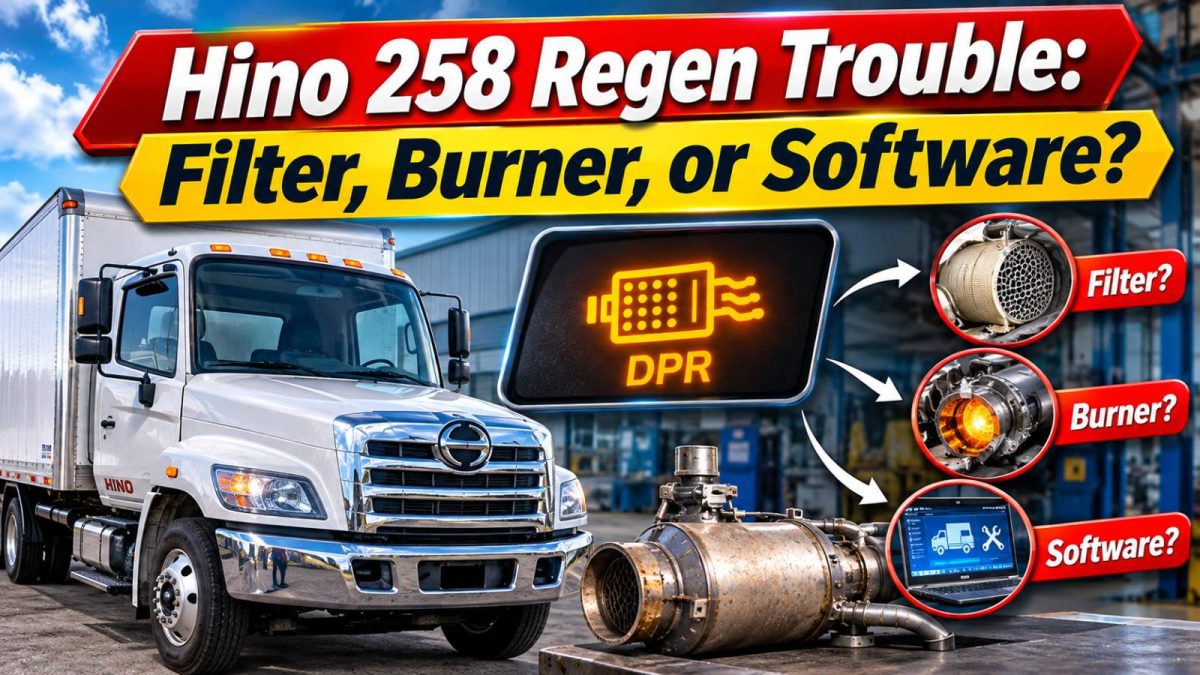
A fleet runs six Hino 258 box trucks on local delivery. One of them starts a manual regeneration, stalls partway, and shows the DPR light again by the afternoon. The shop’s answer is hino dpf filter cleaning in Connecticut , and the filter may well need it. But on this truck, a regen that won’t finish is rarely a filter question first.
What a 2011–2014 Hino 258 is running
Hino’s 238, 258, 268, and 338 conventional trucks from these model years use the J08E engine family, and Hino’s workshop manual covers the J08E-VB and J08E-VC variants. The emissions hardware is what Hino calls DPR, for diesel particulate reduction. It pairs the particulate filter with a burner system and its own control unit, and it regenerates either automatically or through a manual regeneration started from a dash switch.
That burner is the detail that sets these trucks apart. When soot loading rises, the system doesn’t rely only on engine load and exhaust heat. It can fire the burner to raise temperatures. That means a stalled regen can be a burner, valve, or software problem as easily as a loaded filter. Later model years and other Hino lines differ, so check your truck’s documentation.
Why delivery work loads the filter
A 258 on a parcel or grocery route spends the day in short hops, idling at docks, and running light. Exhaust temperatures stay low, so soot builds faster than passive regeneration can clear it. Ash is a separate matter. It’s the residue of burned oil and additives, and no regeneration removes it, so it accumulates until the filter comes off the truck.
The two problems look alike from the driver’s seat. Both end in a DPR light and a request for a manual regen. Only soot responds to that request.
When the manual regen won’t finish
Hino has documented several reasons a regeneration might not complete on these trucks, and none of them is simply a dirty filter. A 2015 Hino bulletin for 2011 through 2014 238, 258, 268, and 338 trucks with a J08 engine says manual regeneration may fail to complete when the burner control unit temporarily detects the combustion air valve sticking. The remedy was a software enhancement. Another bulletin for the same family points to enhanced ECU software where certain engine components are degraded. Hino also issued a troubleshooting procedure for cases where automatic regeneration works but manual regeneration doesn’t, and where the reverse is true.
For a fleet, the takeaway is practical. Hino technicians record data with the Hino DX diagnostic tool while a manual regen runs, so they can see where it stops. Ask your dealer to do that, and ask whether any bulletins, campaigns, or software updates apply to your VIN, before anyone pulls a filter.
Rule out the sensor and the plumbing
A pressure sensor, or the lines feeding it, can report restriction that isn’t there. An exhaust leak near the sensor can skew the reading too. If a scan shows pressure-sensor codes, or pressure readings that jump around instead of tracking engine load, the filter may be fine. There’s a useful rundown of DPF sensor symptoms for sorting a sensor problem from a clogged filter, though your Hino’s own code list governs on the 258.
Upstream causes belong in the same check. Fueling or air problems, an engine using oil, or an exhaust leak can all load the filter faster than normal, and cleaning it behind an unresolved cause just resets the clock.
Removal as part of a service, not a workaround
If the diagnosis points at the filter, it has to come off the truck. Hino DPF filter removal for inspection and cleaning is a normal service step. Hino’s own J08E-VC workshop manual includes a procedure for inspecting the DPR filter with a dedicated check probe inserted from the rear face, so an inspection isn’t an add-on. After inspection, the filter is cleaned, tested, and reinstalled.
That’s different from deleting or bypassing the filter, which violates the federal Clean Air Act. Nothing here covers that, and no reputable shop does it. Hino’s service information also references resetting DPR memory with Hino DX after service, which is worth confirming before the truck goes back on its route.
Cleaning, repair, or replacement
Once the data is in, the answer tends to sort itself out. An intact Hino 258 DPF filter loaded with ash or hardened soot is a cleaning candidate. A stalled regen caused by the burner, the combustion air valve, or software calls for repair or an update. A cracked or melted filter, or one that fails its flow test after cleaning, calls for replacement.
A shop such as 30 Minute DPF Clean lists the Hino 258 among the filters it services. Whoever does the work, ask for inspection findings and before-and-after flow numbers, and keep them with the truck’s records.
Keep the data with the truck
A delivery fleet that notes when each 258 asks for a regen, whether it finished, and what the truck was doing will spot the outlier quickly. The truck that can’t finish a regen while its siblings can is the one to diagnose.